Volume 1
A description of the empire of China and Chinese-Tartary, together with the kingdoms of Korea, and Tibet. Containing the geography and history (natural as well as civil) of those countries ... / from the French of P.J.B. DuHalde, Jesuit, with notes geographical, historical and critical and other improvements, particularly in the maps by the translator.
- Jean-Baptiste Du Halde
- Date:
- 1738-1741
Licence: Public Domain Mark
Credit: A description of the empire of China and Chinese-Tartary, together with the kingdoms of Korea, and Tibet. Containing the geography and history (natural as well as civil) of those countries ... / from the French of P.J.B. DuHalde, Jesuit, with notes geographical, historical and critical and other improvements, particularly in the maps by the translator. Source: Wellcome Collection.
30/794
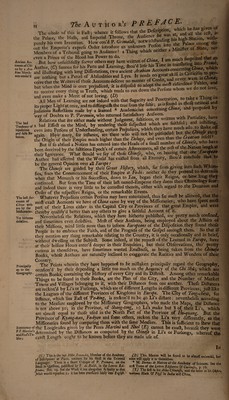
![7*he Author^ PRE FA C Ë• The whole of this is Fad; whence it follows that the De p > ^ an(j the reft, is the Palace, the Halls, and Imperial Throne, the Audience > high Station, with- purely his own Invention. How cou’d P. Grimaldinotwith a g ^ palace among the out the Emperor’s exprefs Order introduce an unknown rei lUinifter of State, nor Members of a Tribunal going to Audience? a Thing which nei e , . . even a Prince of the Blood has Power to do. # r]. T mucj1 forprized that aft Ancient Ac But how unfaithfully foever others may have written of Chtna, 1 am m r imo pmuh counts of Author (C) famous for his Parts and Learning, fhou’d lofe his Time in ti . JVv • ^uich llan Mereh-'and illuftratjpg with long Differtations, two ancient Àccounts concern^^ , ants cenlur’d are nothing but a Parcel of Ab&rdities and Lyes. It needs no ^^^'^‘ were inSL; ceive that the Writers of thofe Accounts deferve no manner of Credit, an p ^ but when the Mind is once prejudiced, it is difpofed to adopt the moft nd.culous FaMra,md to receive every thing as Truth, which tends to run down thePerfons whom we do not love, 'and even make a Merit of not loving. (D) , Tw - All Men of Learning are not indued with that Sagacity and Pénétra ion,. rational^tnd i its proper Light at once, and to diftinguifh the true from the falfe ; as is founi in _r0t50fjk bv * judicious Reflexions made by a learned * Academician concerning > P P way of Doubts to P. Tarennin, who returned SatisfaXory Anfwers. . p . h _ Relations that are either made without Judgment, fiXitious, or written wi ^ infttlline- Tendency Of a bad EffeX on the Mind, by rendering thofe fufpeXed which are faithful, and infti h g, injudicious even into Perfons of Underftanding, certain Prejudices, which they have muc a Carrv again. How many, for inftance, are there who will not be perfuaded but ^ Chnejecwj the Origin of their Empire much higher than the Deluge, and even than the r • But if fo abfurd a Notion has entered into the Heads of a fmall number of ^mefe, who have been deceived by the fiXitious Epoch’s of certain Aftronomers, all the reft of the Nation laugh at their Ignorance. What fhould we fay of thofe Chinefe, who, on hearing that ono^European Author had afferted that the World has exifted from all Eternity, ftiou d conclude that to be the general Opinion over all Europe ? „ . . . r , „r,. The Chinefe are guided by their Great Hiftory, which, far from giving into fuch W him- fies, fixes the Commencement of their Empire at Fo-hi: neither do they pretend to determin when that Monarch or his Succeffors, down to %au, began their Reigns, or how long they continued. But from the Time of their laft named-Emperor they deem their Chronology hirer and indeed there is very little to be correXed therein, either with regard to the Duration and Order of the refpeXive Reigns, or the remarkable Events. j u , Thebeft Ac- Whatever Prejudices certain Perfons may have entertained, thus far .muft be allowed, that the counts of moft. exa& Âccounts we have of China came by way of the Miffionaries ; who have fpent moft fen'by the11' part of their Lives either in the Capital City or Provinces of that great Empire, and were Miffionaries. thereby qualify’d better than any others to give a faithful Account of it. Yet hitherto Neverthelefs the Relations, which they have hitherto publifhed, are pretty much confined,, defective. and fometimes even defeXive. Moft of their Authors, being employed about the Affairs of their Miffions, mind little more than to inform Europeans of the Difpofition they found thofe People in to ’embrace the Faith, and of the Progrefs of the Gofpel amongft them. So that if they mention any thing remarkable relating to the Country, it is only occafionally and in brieÇ without dwelling on the SubjeX. Some indeed, at the requeft of the Learned in Europe, have at their leifure Hours enter’d deeper in their Enquiries ; but their Obfervations, tho’ pretty curious in themfelves, have fometimes wanted ExaXnefs, as being taken from the Chineje Books, whofe Authors are naturally inclined to exaggerate the Rarities and Wonders of their Country. s Principally The Points wherein they have happened to be mift^Icen principally regard the Geography, as to the occafion’d by their depending a little too much on the Accuracy of the Chi Shu; which are Geography. certajn J300ks, containing the Hiftory of every City and its DiftriX. Among other remarkable Things to be found in thefe Books, are the Plan of the City, and the Number of Market Towns and Villages belonging to it, with their. Diftances from one another. Thefe Diftances are reckon’d by Li’s or Furlongs, which are of different Lengths indifferent Provinces; juft like the Leagues of the different Provinces of Kingdoms in Europe. The Cky of Tong-chew, for inftance, which lies Eaft of Te-king, is reckon’d to be 40 Li’s diftant : neverthelefs according to the Meafure employed by the Miffionary Geographers, who made the Maps, the Diftance is not above 30; in the Province, of Shang-tong, 10 Li’s make but 8 of their Li’s, which are almoft equal to thofe ufed in the North Part of the Province of Hu-quang, But the Provinces of Kyang-nan, Fo-kyen and fome others, reckon the Li’s very differently, as the Miffionaries found by comparing them with, the fame Meafure. This is fufficient to fhew that inaccuracy of the Longitudes given by the Peres Martini and Noel (E) cannot be exaX, becaufe they were P'dS3Ta- determined by the Diftances as computed by the Chineje in Li’s or Furlongs, whereof the Iks;**S exrX Length ought to be known before they are made ufe of. (C) This is the late Abbe Renaît dot, Member of the Academy of Infcriptions at Paris, eminent for his Skill in the Oriental Languages. There is a fmart Critique of P. Premare, on the Book in Quellion, publifhed by P. du,Halde, in the Lettres Edi¬ fiantes, Tom. 19. but the Work is not altogether fo faulty as that jditit would reprçfçnt its it has been tranflated lately into Englijb. ' ' In (D) Thh Maxim will be found to be almoft univerfal, but none will apply it to themfelves. * M. Dortous de Mairan of the Academy of Sciences. See the Lettres Edifiantes & Curieujes, p. 76. (E) The firft in his Atlas Chinenfis, and the latter in his Obfer vattona Math. & Pbyf. in India and China>](https://iiif.wellcomecollection.org/image/b30455868_0001_0031.jp2/full/800%2C/0/default.jpg)



 No text description is available for this image
 No text description is available for this image
 No text description is available for this image