Volume 1
A description of the empire of China and Chinese-Tartary, together with the kingdoms of Korea, and Tibet. Containing the geography and history (natural as well as civil) of those countries ... / from the French of P.J.B. DuHalde, Jesuit, with notes geographical, historical and critical and other improvements, particularly in the maps by the translator.
- Jean-Baptiste Du Halde
- Date:
- 1738-1741
Licence: Public Domain Mark
Credit: A description of the empire of China and Chinese-Tartary, together with the kingdoms of Korea, and Tibet. Containing the geography and history (natural as well as civil) of those countries ... / from the French of P.J.B. DuHalde, Jesuit, with notes geographical, historical and critical and other improvements, particularly in the maps by the translator. Source: Wellcome Collection.
38/794
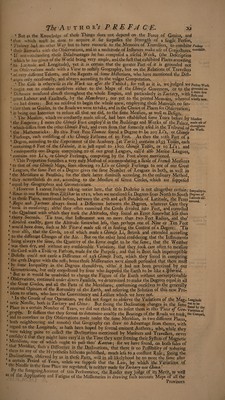
![takes Obfcrvations of the Lon- Not wholly neglected. Work com¬ pared with thole of other c c cd / : ~ Geographers, from TeflJig^ We 4 one x The A u t h o Rk P R E FA CE. ‘ in meafuring we cou’d not return to the fame Point, our Method \vas, as vvepaf^ 4 great Towns already marked down, or other lit Places, to look out or ■ - ^ 4 or Mountains that commanded them; and from time to time we m .’w e 4 Diftance refulting from the Operations (when corrected) agreed wit 1 tie a neceffarv Care for pre- ‘ All thefe Precautions, and many more, too tedious to enumeiate, appear Prince ve.nunS 1 ' <■ when executing a Work, in a Manner worthy the Truft îepofec in us y s proI 4 who judg’d it of the greateft Importance to his State. Moreovei the Hopes o * . fimnorted c tedion, which was neceffary to favour the Progrefs of Chriftiamty in is mp , 4 us amidft thofe Dangers and Croffes- that are unavoidable by thole who av^ e 4 a Variety of Tempers, and are engag’d in fo laborious an Underta]unS • _ -p’ _ 4 willing, for our own Satisfaction, to have repair’d again both to the Eaftern an , 4 tiers, as well as to fome Places within the Kingdom, fituated at convenient Alliances, ithere gitüdc for ve- c to examine the Longitudes by repeated Obfervations of Eclipfes; but as , . Work/ 4 finilhed,.and the Emperor appeared latisfy’d with it, we did not think it proper oengag 4 in a new and not altogether necelfary Affair. ir f 4 We therefore contented ourfelves with Obfervations of the Moon and c ate 1 es o j p 4 made before our Time in lèverai Cities by Members of our Society,^ tho we reje e a \ 4 becaufe they did not agree with our Meafures, on account of fome Imall Error as o in 4 the Obfervation, which but too often happens to the moft experienced, i o • u a we 4 ourfelves obferved fome Eclipfes of the Moon (X) and found no other Di erence in our 4 Obfervations than is ufual in fuch Cafes; where we had any doubt we chofe the mean Di eience. 4 Thus having firft made ufe of the Method of Triangles for determining the Durances e 4 the feveral Cities, and afterwards compared it with that of Eclipfes obferved in Placesurem e Aim, we flatter ourfelves that we have followed the fureft Courfe, and even the on Y praticable, in profëcuting the greatejl Geographical Work that ercer was perjorwea 4 according to the Rules of Art. < ' More accu- 4 Thofe who have publilhed Maps of Europe, or any particular Kingdom thereof, have lel- rate than the c dom taken the pains themfelves to examine the Situation of Places on the Spot. They are jvhipsof i cont-enj- either with fuch Obfervations as they can pick up, made by Perfons of very unequal 4 Abilities; or with collecting the itinerary Diftances, which are fcarce ever alike in different 4 Provinces; with procuring the Relations of Travellers, who commonly give the Diftances from 4 Report; and with ranging their Materials, partly according to fome of thofè Obier vat ions, and 4 partly by Conjecture. : . . 4 Thus we need not wonder, if Ttolomy himfelf, the Reftorer (T) of Aftronomy and Geogra- 4 phy, has committed confiderable Faults; not only in fpeaking of China, whofe Capital he places in three Degrees of South Latitude, but with refpeét to Africa and Europe, both 4 which the Alexandrians were fo well acquainted with. Not that he negleCted to confiilt the' 4 Aftronomical Obfervations of thofe who preceded him; for he cites and follows them, fo far 4 as to maintain, (on the Authority of the celebrated Tytheas of MarfeiUes) what paffed then 4 for a Falsehood, viz. that in the Ifle of Houle^ to which he failed from the Pillars of Herculesy 4 the Sun at the Summer Solftice rofe a little after it fet. Ttolomy had alfo the moft efteem’d 4 Itineraries, fuch as that attributed to the Emperor Antoninus, (in whofe Reign he lived) 4 fuppofed to be a Compend of the Diftances meafnred by the Senate throughout the Roman 4 Empire: Whereof the general Description, under the Name of The whole World, form’d 4 from Agrippa’s Memoirs, was by Augufus expofed in a magnificent Portico at Rome: 4 Nor is it to be doubted but Ttolomy was acquainted with the Defcriptions Alexander 4 caufed to be made of his Conquefts. However it is certain that thofe Materials were infuf- 4 ficient for making a Geography of the whole Earth, or even a confiderable Part of either 4 Europe or Afia, with any tolerable Accuracy. Befides, how among the antient Obfervations fiiall 4 we diftingufth the good from the bad ? which yet is neceffary in order to have exad Maps; for 4 an Error in Aftronomical Obfervations, which difappears on account of the great Diftance ‘ of the Heavens, fhews itfelf at firft fight in a Map, by means of the Relation it has c to the neighbouring Places known to every Traveller. How could Ttolomy know Uncertainty rhe juft Proportion of Diftances, meafured feveral Ages before, under quite different Govern- “ 4 meats, among barbarous as well as civilized Nations, and in fome fort determined by the Ample ‘ Eftiaiation of a Ship’s Courfe, which, tho’ made by able Men, (fuch as Tolybius, Nearchus 4 and One (1er it us ; the firft fent by Scipio to the Coafts of Africa and Spain, the others by 4 Alexander to difeover the Terfan Gulf) muft have their Defers too; and fuppofing they 4 had not, there ftill remains a Difficulty, almoft infuperable, which is, to determine precifely how 4 much of the Roads is to be retrenched, in order to fix the exact Diftance in a lirait Line from Difficulty of 4 one city to another. Altho’ Ttolomy, for inftance, had a much more particular Account of u!ndin|ofr ' the Diftances from the Cafpian Sea to the Indian Ocean, as meafured by Diogenetes and Beta Roads. 4 at the Command of Alexander, than we find in the fixth Book of Tliny ; yet if he never was 4 on the Spot, to mark all the Windings and different Bearings of the Road, occafioned by the 4 various Difpofition of the Lands, it was not poflible for him to determine, exa&ly, either 4 the Polit ion of Towns, or Paffages of Rivers, much lefs the intire Courfe, merely by a few 4 Points only ; nor to afeertain the Dimenfions of a Country, by means of one or two Geogra- 4 phical Lines, without having the intermediate Points, which are abfolutely neceffary to 4 connect the one with the other. But * Agathem. {X) Thefe Obfervations may be feen in Pere Souclefs Obfcrvat. thought) of thofe Sciences, which were cultivated down to his Time ; Geogr. /. i. Mathemat. p. 35, & feqq. one ofthe Antients themfelves tells us, that in Matters o:Geography’, c. 6. {V) Ttolomy* was the Improver, not the Reftorer (as is commonly he followed thofe who went before him, inventing nothing of his own. (Defefts of Ptolomy's Ge ography. Obfervations not diftin- guifh’d in his Tables.](https://iiif.wellcomecollection.org/image/b30455868_0001_0039.jp2/full/800%2C/0/default.jpg)




 No text description is available for this image
 No text description is available for this image
 No text description is available for this image