Volume 1
A description of the empire of China and Chinese-Tartary, together with the kingdoms of Korea, and Tibet. Containing the geography and history (natural as well as civil) of those countries ... / from the French of P.J.B. DuHalde, Jesuit, with notes geographical, historical and critical and other improvements, particularly in the maps by the translator.
- Jean-Baptiste Du Halde
- Date:
- 1738-1741
Licence: Public Domain Mark
Credit: A description of the empire of China and Chinese-Tartary, together with the kingdoms of Korea, and Tibet. Containing the geography and history (natural as well as civil) of those countries ... / from the French of P.J.B. DuHalde, Jesuit, with notes geographical, historical and critical and other improvements, particularly in the maps by the translator. Source: Wellcome Collection.
48/794 page 4
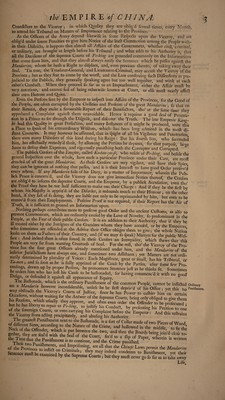
![Punifhments of Criminals. Raifing of Taxes. Life, except the Nature of the Crime require fpeedy Juftice, as in Cafes of Sedition, o * then the Emperor gives Authority to the Ffong-tû, and even to the Viceroy, to pumüi t ders with immediate Death* , . , A is true, the Law which requires all Caufes relating to capital Offences to e tran mitte Court, would in Europe appear very inconvenient : But in China great Inconveniences w°u the confequence of giving the Mandarins Power over the Lives of the People 5 wherefore tne l*- giflators, who know the difpofition of the Nation, have thought it neceffary to take that, rower out of their Hands. . „ . The three capital Punifhments are Strangling, Beheading, and cutting in Pieces * is a 19 inflicted on none but Rebels, thofe who murder their Mailers, and mercilefs Robbers. The firft is the moll common Punifhment which the Court adjudges thofe to, whô are wor¬ thy of Death. Beheading is the next : The condemn’d Perfon is not expofed on a Scaffold on the Day of Execution j but being made to kneel in fome public Place, with his Hands Led behind, one Executioner holds him fo faff that he cannot move, while another coming behind takes oft his Head at one Stroke, and at the fame time lays him on his Back with fuch Dexterity, that not one Drop of Blood falls On his Cloaths, which on that Occafion are often better than ordi¬ nary : His Relations and Friends, who are afhamed to own him in thofe unhappy Circum- fiances, commonly fend him new Cloaths, and caufe Provifions and Drink to be furnifh d him, by the way. The Executioner is commonly a Soldier, nor is the Office feandalous, but the contrary, if they perform it well. At Pe-king, he accompanies the Criminal, girt with an Apron of yellow Silk, which is the Imperial Colour ; and his Cutlas is wrap’d in Silk of the fame kind, to fhew that he is veiled with the Emperor’s Authority, and to command the greater Refpeét from the People. Indeed in Chinefe Authors, mention is made of feveral other kinds of Punilhments, fome of them alfo pretty extraordinary ; but it mull be obferved, at the fame time, that they have never been inflicted by any but barbarous Princes, who were look’d on as Tyrants by the whole Na¬ tion; Juftice, fay they, is neceffary, but not Cruelty. But though the Power of the Magiftrate be reftrain’d by the Laws in criminal Matters, it Î9 in a manner abfolute in civil Cafes : Since all Affairs, which merely regard private Property, are determin’d by the great Officers of the Provinces, without Appeal to the fbvereign Courts of Pe-king, except in Matters of greatell Confequence. That which chiefly employs the inferior Mandarins, whether they be the Chi-chew, Chi-hyeny or Wey-fhew-pey, is gathering of the Taxes, and it requires their perfonal Attendance. Altho* the Lands in every Province are meafured, and what every (g) Arpent is to pay be adjulled, accord¬ ing to the Goodnefs of the Soil ; yet whether through Poverty, or Avarice, the People are ufually unwilling to part with it, till the inferior Officers come and harals them for it, being fometimes conftrain’d to make ufe of Blows. When thefe Tax-gatherers are reproached for their Severity in preffing the Payment, they excufe themfelves by faying, That when they are fent into the Villa¬ ges to levy the Tax, Ihould they not bring it home with them, their Mailers would fufpeft either that they had negledted their Duty, or had taken Bribes ; which bare Sufpicion, without farther Examination, would be fufficient to procure them the Ballonade. The Mandarins on the other hand -pretend to juftify their Condudt, by the Neceffity they are under of ading in that manner j alledging, that having failed of colleding the Dues in the appointed Time, they have been obliged more than once to pay the Emperor out of their own Pockets, for fear of iofing their Employ¬ ments; which is a Fad known to all thofe who are acquainted with Affairs ; befides, feveral Pro¬ vinces are greatly in Arrear to the Royal Treafury, which probably will never be paid. But to remedy this Inconvenience, the prefent (h) Emperor has ordered that, for the future, the Proprie¬ tors of the Lands, and not the Occupiers, Ihall pay the Taxes. * * Befides the great Mandarins of every Province, as before mentioned, there is one Hill more con- fiderable, call’d Pfong-tu. His Jurifdidion extends over two Provinces ; or, Ihould we compare the Viceroys to our Intendants, [in France] (tho’ there is a great Difference in refped to their Au¬ thority, and the Extent of their Jurifdidion) it comprehends at leall two Generalities : For in the larger Provinces, fuch as Hû-quang, Shen-fi, &c. the Pfong-tu has the Care only of one Province * but then it is divided into two Governments, and each Government has its proper Viceroy * How far the Power of this fuperior Governor extends over the other Viceroys, is determined both by the Laws and Cuftom : For he is their Superior only in certain Matters : but he has alwavs a Right of deciding Caufes, in cafe of Appeals from the Tribunals of either of the Provincial Go. vernors. Having given this general Account of the Magnates and their Jurifdiaions, it will be proper to exhibit the Names of tire Provinces, and the Cities belonging to each : This is the more necef- ffary as we find many Errors in the printed Relations; probably either becaufe the Authors have followed the old Catalogues, without confidering the Difference between the Times thev were made in, and the prefent; or elfe have relied on the Report of their Chinefe Friends u7 altho’ they are Batchelors and Doitors, are often as little acquainted with their Count™’ LaWD-ft'■<?Ur°pe’ Wh° n6Ver take any pains t0 know more of the Land than lies wUhin heir (c) Arpent is a Meafure of Land, containing ioo Perches Square, of 18 Foot each. <H) n„s Chir-l, who died ia the Year 1736. There](https://iiif.wellcomecollection.org/image/b30455868_0001_0049.jp2/full/800%2C/0/default.jpg)