Studies upon the plague situation in North China / by Wu Lien-teh [and others].
- Date:
- [1929?]
Licence: In copyright
Credit: Studies upon the plague situation in North China / by Wu Lien-teh [and others]. Source: Wellcome Collection.
69/144 (page 339)
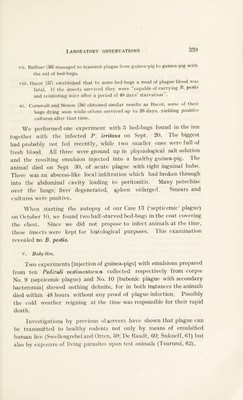
![vii. Balfour (56) managed to transmit plague from guinea-pig to guinea-pig with the aid of bed-bugs. viii. Bacot (57) established that to some bed-bugs a meal of plague blood was fatal. If the insects survived they were “capable of carrying B. pestis and reinfesting mice after a period of 48 days starvation . xi. Cornwall and Menon (58) obtained similar results as Bacot, some of theii bugs dying soon while others survived up to 38 days, yielding positive cultures after that time. We performed one experiment with 3 bed-bugs found in the inn together with the infected P. irritans on Sept. 20. the biggest had probably not fed recently, while two smaller ones were full of fresh blood. All three were ground up in physiological salt solution and the resulting emulsion injected into a healthy guinea-pig. The animal died on Sept 30, of acute plague with right inguinal bubo. There was an abscess-like local infiltration which had broken through into the abdominal cavity leading to peritonitis. Many petechiae over the lungs; liver degenerated, spleen enlarged. Smears and cultures were positive. When starting the autopsy of our Case 13 ('septicemic/ plague) on October 10, we found two half-starved bed-bugs in the coat covering the chest. Since we did not propose to infect animals at the time, these insects were kept for histological purposes. This examination revealed no B. pestis. C. Body-lice. Two experiments [injection of guinea-pigs] with emulsions prepared from ten Pediculi vestimentorum collected respectively from corpse No. 9 (septicemic plague) and No. 10 [bubonic plague with secondary bacteremia] showed nothing definite, for in both instances the animals died within 48 hours without any proof of plague infection. Possibly the cold weather reigning at the time was responsible for their rapid death. Investigations by previous observers have shown that plague can be transmitted to healthy rodents not only by means of emulsified human lice (Swellengrebel and Otten, 59; De Raadt, 60; Sukneff, 61) but also by exposure of living parasites upon test animals (Tsurumi, 62).](https://iiif.wellcomecollection.org/image/b29822725_0069.jp2/full/800%2C/0/default.jpg)