An introduction to pathology and morbid anatomy / by T. Henry Green.
- Green, T. Henry (Thomas Henry), 1841-1923
- Date:
- 1871
Licence: Public Domain Mark
Credit: An introduction to pathology and morbid anatomy / by T. Henry Green. Source: Wellcome Collection.
Provider: This material has been provided by the Francis A. Countway Library of Medicine, through the Medical Heritage Library. The original may be consulted at the Francis A. Countway Library of Medicine, Harvard Medical School.
295/304 (page 31)
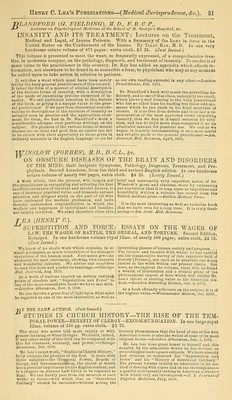
![JDLANDFORD (G. FIELDING), M. D., F. R. G P., J-^ Lecturer on Psychological Medicine at the School of St. George's Hospital, &c. INSANITY AND ITS TREATMENT: Lectures on the Treatment, Medical and Legal, of Insane Patients. With a Summary of the Laws in force in the United States on the Confinement of the Insane. By Isaac Rat, M. D. In one very handsome' octavo volume of 471 pages : extra cloth, $3 25. {Jzist Issued.) This volume is presented to meet the want, so frequently expressed, of a comprehensive trea- tise, in moderate compass, on the pathology, diagnosis, and treatment of insanity. To render it of more value to the practitioner in this country, Dr. Eay has added an appendix which affords in- formation, not elsewhere to be found in so accessible a form, to physicians who may at any moment be called upon to take action in relation to patients. It satisfies a want which must have been sorely felt by the busy general practitioners of this country. It takes the form of a manual of clinical description of the various forms of insanity, with a description of the mode of examining persons suspected of in- sanity. We call particular attention to this feature of the book, as giving it a unique value to the gene- ral practitioner. If we pass from theoretical conside- rations to descriptions of the varieties of insanity as actually seen in practice and the appropriate treat- ment for them, we find in Dr. Blandford's work a considerable advance over previous writings on the subject. His pictures of the various forms of mental disease are so clear and good that no reader can fail to be struck with their superiority to those given in ordinary manuals in the English language or (so far as our own reading extends) in any other.—London Practitioner, Feb. 1S71. Dr. Blandford's book well meets the prevailing de- ficiency, and is one of that class, unhappily too small, which prove a real blessing to the busy practitioner who has no other time for reading but those odd mo- ments which he can catch in his brief intervals of leisure. It is so free from defects and is so fair a re- presentation of the most approved views respecting insanity, that we find in it small occasion for criti- cism, and can do little more than commend it as an admirable manual for practical use. We end as we began, in heartily recommending it as a most useful and reliable guide to the general practitioner.—Atn. Journal Med. Sciences, April, 1871. 'VU'INSLOW {FORBES), M.D., D.G.L., ^c. ON OBSCfURE DISEASES OF THE BRAIN AND DISORDERS OF THE MIND; their incipient Symptoms, Pathology, Diagnosis, Treatment, and Pro- phylaxis. Second American, from the third and revised English edition. In one handsome octavo volume of nearly 600 pages, extra cloth. $4 25. (Lately Issued.) A work which, like the present, will largely aid the practitioner in recognizing and arresting the first Insidious advances of cerebral and mental disease, is one of immense practical value, and demands earnest attention and diligent study on the part of all who have embraced the medical profession, and have thereby undertaken responsibilities in which the welfare and happiness of Individuals and families are largely involved. We sh«,ll therefore close this brief and necessarily very imperfect notice of Dr. Winslow's great and classical work by expressing our conviction that it is long since so important ana beautifully written a volume has issued from the British medical press.—IiuUin Medical Press. It is the most interesting as well as valuable book that we have seen for a long time. It is truly fasci- nating.—Am. Jour. Med. Sciences. EA [HENRY C). 'superstition AND FORCE: ESSAYS ON THE WAGER OF LAW, THE WAGER OF BATTLE, THE ORDEAL, AND TORTURE. Second Edition, Enlarged. In one handsome volume royal 12mo. of nearly 600 pages; extra cloth, $2 75. (Jiisi Issued.) interesting phases of human society and progress. . . The fulness and breadth with which he has carried out his comparative survey of this repulsive field of history [Torture], are such as to preclude our doing justice to the work within our present limits. But here, as throughout the volume, there will be found a wealth of illustration and a critical grasp of the philosophical import of facts which will render Mr. Lea's labors of sterling value to the historical stu- dent.—London Saturday Review, Oct. S, 1S70. We know of no single work which contains, in so small a compass, so much illustrative of the strangest operations of the human mind. Foot-notes give the authority for each statement, showing vast research and wonderful industry. We advise our confr&res to read this book and ponderits teachings.—Chicago Med. Journal, Aug. 1870. As a work of curious inquiry on certain outlying points of obsolete law, Superstition and Force is one of the most remarkable books we have met with. —London AthencBum, 2fov. :i, 18(56. He has thrown a great deal of light upon what must be regarded as one of the most instructive as well as As a book of ready reference on the subject, it is of the highest value.— Westminster Review, Oct. 18(57.^ B r THE SAMS A UTHOR. [Just Issued.) STUDIES IN CHURCH HISTORY—THE RISE OF THE TEM- PORAL POWER—BENEFIT OF CLERGY—EXCOMMUNICATION. In one large royal 12mo. volume of 516 pp. extra cloth. $2 75. The story was never told more calmly or with greater learning or wiser thought. We doubt, indeed, if any other study of this field can be compared with this for clearness, accuracy, and power. — Chicago Examiner, Dec. 1870. Mr. Lea's latest work, Studies in Church History, fully sustains the promise of the first. It deals with three subjects—the Temporal Power, Benefit of Clergy, and Excommunication, the record of which has a peculiar importance for the English student, and Is a chapter on Ancient Law likely to be regarded as final. We can hardly pass from our mention of such works as these—with which that on Sacerdotal Celibacy should be included—without noting the literary phenomenon that the head of one of the first American houses is also the writer of some of its most original books.—London Athenoium, Jan. 7, 1S71. Mr. Lea has done great honor to himself and this country by the admirable works he has written on ecclesiologicaland cognate subjects. We have already had occasion to commend his Superstition and Force and his History of Sacerdotnl Celibacy. The present volume is fully as admirable iu its me- thod of dealing with topics and in the thoroughneso— aquality so frequently lacking in American authors— with which they are investigated.—iV^. Y. Jou-rnaiof Psychol. Medicine, July, l»;o.](https://iiif.wellcomecollection.org/image/b21055191_0295.jp2/full/800%2C/0/default.jpg)