Licence: Public Domain Mark
Credit: Hand-book of physiology / by W. Morrant Baker and Vincent Dormer Harris. Source: Wellcome Collection.
Provider: This material has been provided by the Royal College of Physicians of Edinburgh. The original may be consulted at the Royal College of Physicians of Edinburgh.
47/930 (page 19)
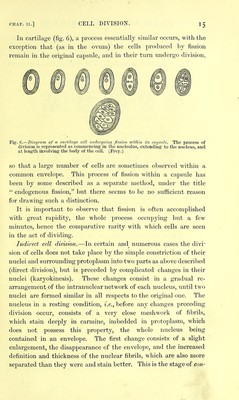
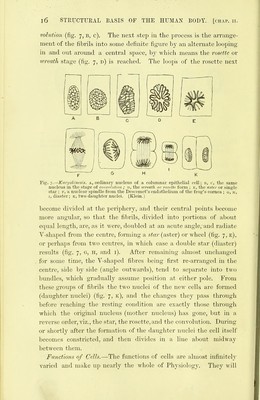
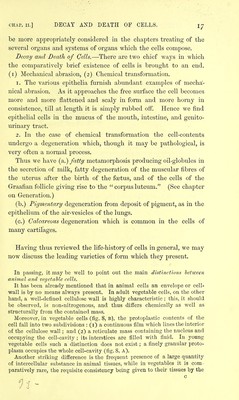
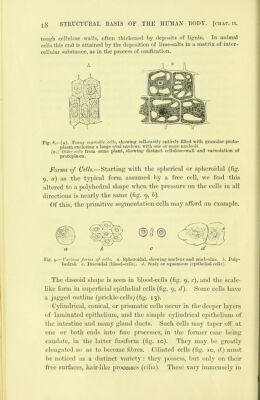
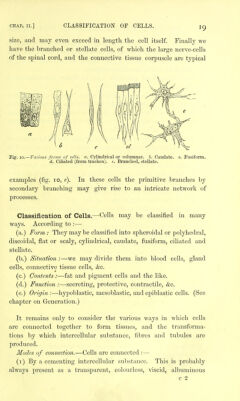
![CHAP. II.] CLASSIFICATION OF CELLS. size, and may even exceed in length the cell itself. Finally we have the branched or stellate cells, of which the large nerve-cells of the spinal cord, and the connective tissue corpuscle are typical Fig. 10.— Various forms of ceJJs. a. Cylindrical or columnar. ?>. Caudate, c. Fusiform. d. Ciliated (from trachea), e. Branched, stellate. examples (fig. lo, e). In these cells the primitive branches by secondary branching may give rise to an intricate network of processes. Classification of Cells.—Cells may be classified in many ways. According to :— (a.) Form: They may be classified into spheroidal or polyhedral, discoidal, flat or scaly, cylindrical, caudate, fusiform, ciliated and stellate. (b.) Situation :—we may divide them into blood cells, gland cells, connective tissue cells, &c. (c.) Contents:—fat and pigment cells and the like. (d.) Function:—^secreting, protective, contractile, &c. (e.) Origin:—hypoblastic, mesoblastic, and epiblastic cells. (See chapter on Generation.) It remains only to consider the various ways in which cells are connected together to form tissues, and the transforma- tions by which intercellular substance, fibres and tubules are produced. Modes of connection.—Cells are connected :— (i) By a cementing intercellular substance. This is probably always present as a transparent, colourless, viscid, albuminous](https://iiif.wellcomecollection.org/image/b21906300_0047.jp2/full/800%2C/0/default.jpg)