Licence: Public Domain Mark
Credit: Hand-book of physiology / by W. Morrant Baker and Vincent Dormer Harris. Source: Wellcome Collection.
Provider: This material has been provided by the Royal College of Physicians of Edinburgh. The original may be consulted at the Royal College of Physicians of Edinburgh.
97/930 (page 69)
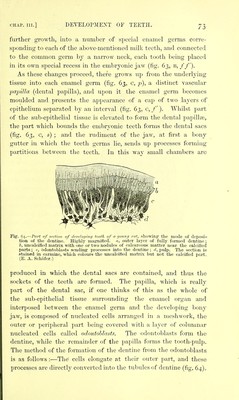
![CHAT. iJi.] TEETH: DEXTINE. matter ; the proportion in a hundred parts being about twenty- eight animal to seventy-two of earthy. The former, like the animal matter of bone, may be resolved into gelatin liy boiling. The earthy matter is made up chiefly of calcium pliosphate, with a small-portion of the carbonate, and traces of calcium fluoride and magnesium phosphate. Structure.—Under the microscope dentine is seen to be finely channelled by a multitude of delicate tubes, Avhicii, l)y their inner ends, communicate with the pulp-cavity, and by their outer ex- tremities come into contact with the under part of the enamel and r ./ fl (■ b Pig. 60.—Section of a portion of tfif iJi'ittine and cement from the middle of the root of an incisor tooth, a, dental tubuli ramif jing and terminating, some of them in the inter- globular spaces h and c, which somewhat resemble bone lacuna?; d, inner layer of the cement witli numerous i;loscly set caualiculi; c, outer layer of cement; /, lacunee; ij, canaliculi. x 350. (KuUiker.) cement and sometimes even penetrate them for a greater or less distance (fig. 60). In their course from the pulp-cavity to the surface of the dentine, the minute tubes form gentle and nearly parallel curves and divide and subdivide dichotomously, but without much lessening of their calibre until they are approaching their peri- pheral termination. From their sides proceed other exceedingly minute secondary canals, which extend into the dentine between the tubules, and anastomose with each other. The tul)ules of the dentine, the average diameter of which at their inner and larger extremity is fii00 inch, contain fine prolongations from the tooth-pulp, which give the dentine a certain faint sensitiveness under ordi- nary circumstances and, without doul)t, have to do also with its nutrition. These prolongations from the tooth-pulp are really processes of the dentine-cells or odontoblasts which are branched](https://iiif.wellcomecollection.org/image/b21906300_0099.jp2/full/800%2C/0/default.jpg)