Studies upon plague in ground squirrels (in four parts) ... : II. A plague-like disease of rodents / by George W. McCoy.
- McCoy, George W.
- Date:
- 1911
Licence: Public Domain Mark
Credit: Studies upon plague in ground squirrels (in four parts) ... : II. A plague-like disease of rodents / by George W. McCoy. Source: Wellcome Collection.
55/98 page 53
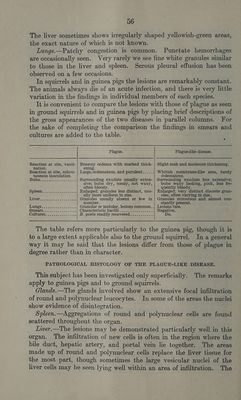
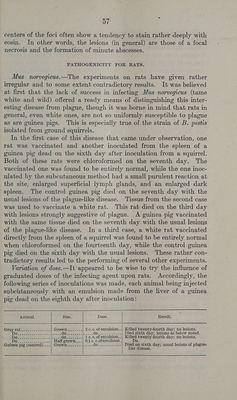
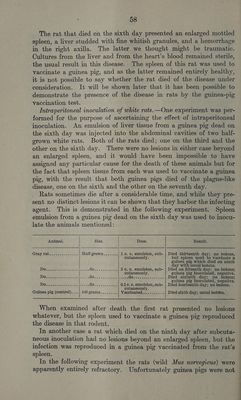
![A PLAGUE-LIKE DISEASE OF RODENTS. [From the Federal laboratory, San Francisco, Cal.] By Grora@e W. McCoy, Passed Assistant Surgeon. During the routine examination of ground squirrels we have encountered an infection the lesions of which are readily mistaken for those of plague. This disease also causes pathological changes in . guinea pigs that are almost indistinguishable from those due to infec- tion with B. pestis and occasionally produces plague-like lesions in rats and mice. It is barely possible that we unknowingly have dealt with more than one disease entity, as no etiological agent has been discovered, and for a diagnosis we are compelled to rely upon the lesions produced in laboratory animals and the negative results of microscopical and cultural investigations. The post-mortem appearances in guinea pigs, where they are remarkably uniform and constant, afford the chief evi- dence upon which a diagnosis is based. GEOGRAPHICAL DISTRIBUTION. The disease has been observed in squirrels coming from many points. We have found it in those from nine counties, all lying be- tween Los Angeles on the south and the Sacramento River on the north. The infection has been discovered in districts and even on ranches that have furnished plague squirrels as well as in those sections in which plague has not been demonstrated. GROSS LESIONS. GROUND SQUIRRELS NATURALLY INFECTED. The following description is based upon the examination of 32 squirrels so infected: Bubo.—The bubo is usually about the size of a pea, often larger, rather firm, and when cut presents a dry, yellowish, or blood-stained surface. Some hemorrhage is frequently found in the surrounding tissue. The gland structure is generally replaced by a firm caseous mass. Purulent glands have been seen, but are not common. In about 20 per cent of the cases a bubo was the only lesion observed. Spleen.—When involved this organ is very much enlarged, perhaps to four or five times the normal size. It is fairly firm in consistency unless post-mortem changes have occurred. The color is generally](https://iiif.wellcomecollection.org/image/b3346750x_0055.jp2/full/800%2C/0/default.jpg)
 No text description is available for this image
 No text description is available for this image
 No text description is available for this image