Licence: Public Domain Mark
Credit: The rectum and anus : their diseases and treatment. Source: Wellcome Collection.
Provider: This material has been provided by the Augustus C. Long Health Sciences Library at Columbia University and Columbia University Libraries/Information Services, through the Medical Heritage Library. The original may be consulted at the the Augustus C. Long Health Sciences Library at Columbia University and Columbia University.
312/438 (page 288)
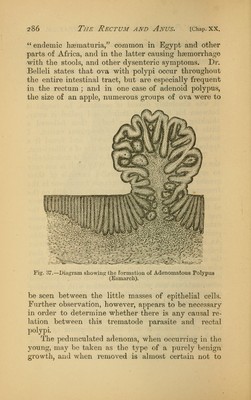
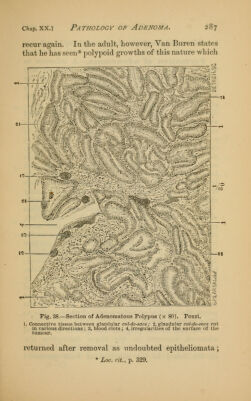
![but this experience does not appear to have been borne out by other observers. Formatioii of adenomata.—A reference to the diagram (Fig. 37) taken from Esmarch will show that (as is seen on the left-hand side of the figure) the first step in the production of polypus is an increase in length and hypertrophy of the follicles of Lieberkiihn, and at the same time the cylin- drical cells lining these tubes become elongated and enlarged. The result of this is that the mucous membrane at this point buckles up and projects as a tumour. As the follicles become increased in number and size they become more and more con- voluted (Figs. 38 and 39). The tumour now oflers some resistance to the passing mass of faeces, and becomes dragged down, the circular fibres of the bowel also assisting to expel the tumour. The pedicle of mucous membrane is thus formed, and gradually elongates until the polypus comes to touch the anus. If a section be made passing through the hilum of one of these little growths, it will be found that, starting from that point, bands of connective tissue radiate in all directions to the circumference of the polypus, and between these are numerous secondary offshoots ; the little spaces thus left are packed with Lieberkiihn's follicles considerably larger than normal; the section appears as if these were closed cavities, but in all probability this appearance is produced by the line of section traversing convoluted tubes; and this ])robability is rendered greater by the fact that numlDers of these tubes open on the surface of the polyp, the roughly granular aspect of which is due to the numerous orifices. The idea of the progress and growth of a rectal adenoma, conveyed in the above description {i.e. the idea of tendency to outgrowth into the lumen of the bowel in the direction of least pressure;](https://iiif.wellcomecollection.org/image/b21229387_0312.jp2/full/800%2C/0/default.jpg)