Licence: Public Domain Mark
Credit: The rectum and anus : their diseases and treatment. Source: Wellcome Collection.
Provider: This material has been provided by the Augustus C. Long Health Sciences Library at Columbia University and Columbia University Libraries/Information Services, through the Medical Heritage Library. The original may be consulted at the the Augustus C. Long Health Sciences Library at Columbia University and Columbia University.
316/438 (page 292)
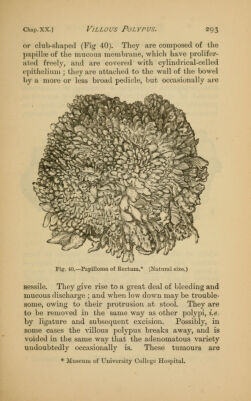
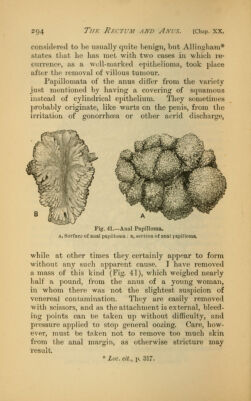
![at its upper extremity, are of this nature; and small polypi of this kind are also found not infrequently as- sociated with internal piles. They consist of an over- growth of the loose connective tissue of the submucosa, covered by mucous membrane ; but occasionally they assume large size, as in the case recorded by Mr. A. A. Bowlby.* A woman, while straining at stool, felt something come down which she was unable to return. An examination showed a tumour the size of a foetal head, attached by a pedicle 1| inches in diameter to the anterior wall of the rectum, about 4 inches up. The base was transfixed and ligatured, and the mass cut away. It weighed 2 lbs. all but one ounce; and section showed it to be composed of loose connective tissue, the meshes of which contained a viscid fluid. A case is also recorded by Dr. Barnes,! in which a tumour in the rectum, the size of an orange, obstructed labour, and was removed by the galvanic cautery. It proved to be a connective tissue tumour, in part cavernous. A variety of neoplasm termed hard polypus, which is extremely rare, would appear to be, in some in- stances, a true fibroma; while, according to Allingham, there is a specimen of polypus in the Hunterian Museum, originating from the muscular wall of the bowel, and in structure similar to the tibro-myomata, so commonly met with in the uterus. 3. Papilloma. [Villous tumour of rectum (Curling); Villous polypus (Esmarch); and Gran- ular papilloma (Gosselin)].—Under these various terms is desci'ibed a remarkable but rare form of rectal growth, resembling in general appearance the villous tumour of the bladder, with this slight differ- ence, however: that the lobes in the bladder tumour are more filiform, while in the rectum they are flattened * Transactions of the London Pathological Society, 1883. t British Medical Journal, p. 551; April 12, 187'J.](https://iiif.wellcomecollection.org/image/b21229387_0316.jp2/full/800%2C/0/default.jpg)