Licence: Public Domain Mark
Credit: The rectum and anus : their diseases and treatment. Source: Wellcome Collection.
Provider: This material has been provided by the Augustus C. Long Health Sciences Library at Columbia University and Columbia University Libraries/Information Services, through the Medical Heritage Library. The original may be consulted at the the Augustus C. Long Health Sciences Library at Columbia University and Columbia University.
346/438 (page 322)
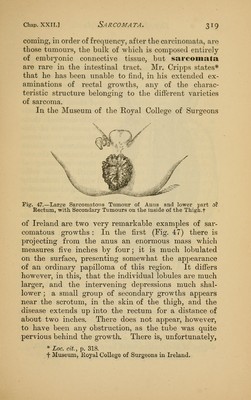
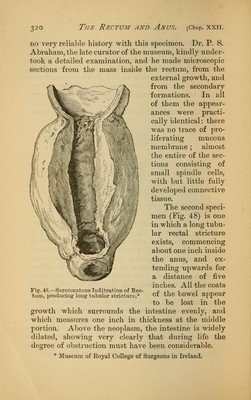
![June, 1884, at Sir Patrick Dun's Hospital. He complained of piles and difficulty in getting the bowels to move. U])on making an examination a tumour was felt in the hollow of the sacrum, obstructing the rectum. The raucous membrane was freely mov- able over it, and the tumour itself was movable in the pelvis. As I thought, from the movability of the mucous membrane over it, that it was out- side the intestine, I attempted its removal by linear proctotomy. When reached it was found to be very soft, and it broke down under the linger. As much as possible of it was removed. The patient, however, died of septic periproctitis. At the post- mortem, it was found that the neoplasm infiltrated and thickened considerably the posterior portion of the muscular wall of the rectum, the new growth in parts above where it was removed being one and a half inches thick. The mucous coat was en- tirely unaffected, and freely movable over the growth, which appeared to have originated in the muscular coat of the bowel. The pelvic and lumbar glands were all very much enlarged, but with this exception there did not appear to be any general disease of the lymphatic system. Microscopic examination was kindly made by Dr. Abraham, who states that it was in all respects similar to the descriptions given of lympho-sarcoma.. Melanotic sarcoma.—Primary melanotic can- cer of the rectum is extremely rare ; and according to Yirchow this is the only portion of the intes- tinal tract in which it has been found. Mr. Treves, however, states that there is a specimen of appa- rently primary melanotic gi'owth arising from the ileum at the London Hospital Museum ; and there is an example of melanotic growth in the colon in the Museum of Trinity College, Dublin, but as there were apparently (from the history) similar growths in](https://iiif.wellcomecollection.org/image/b21229387_0346.jp2/full/800%2C/0/default.jpg)