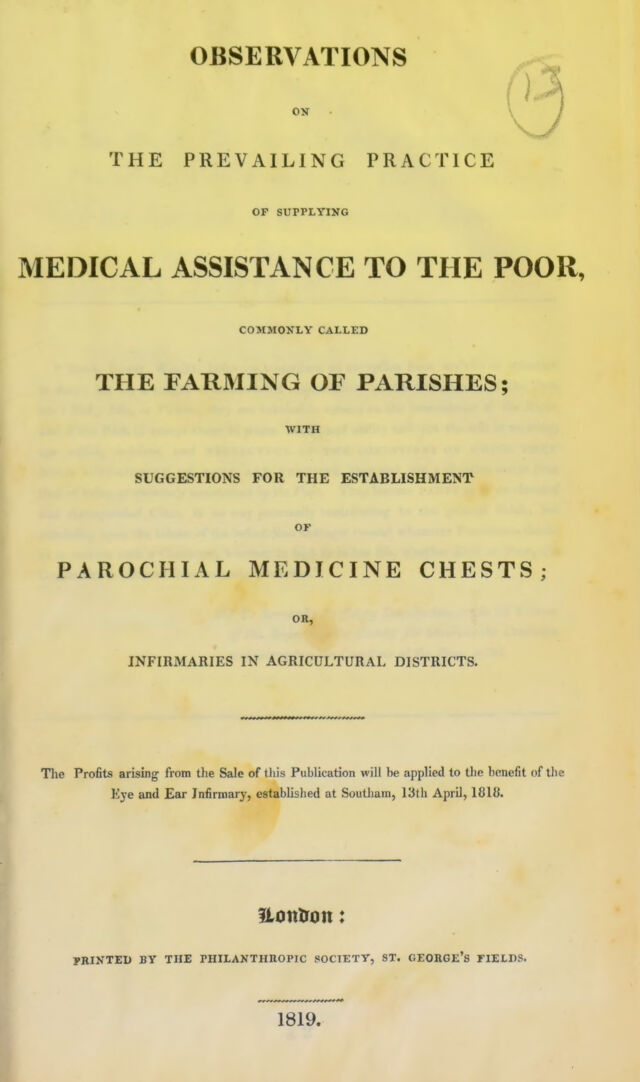
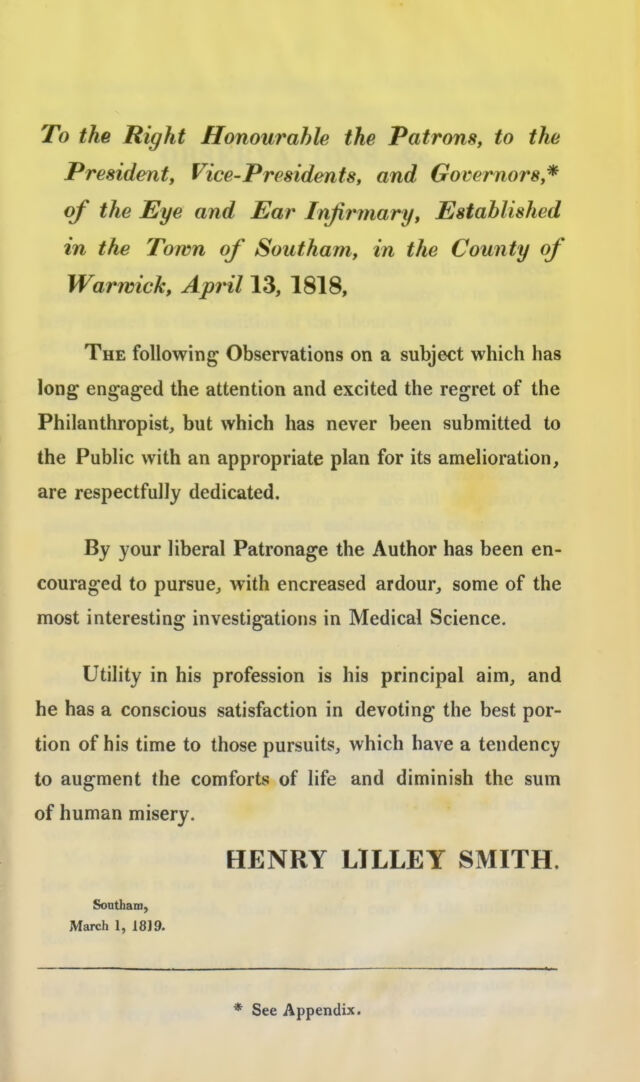
Observations on the prevailing practice of supplying medical assistance to the poor, commonly called the farming of parishes : with suggestions for the establishment of parochial medicine chests; or, infirmaries in agricultural districts.
- Henry Lilley Smith
- Date:
- 1819
Licence: Public Domain Mark
Credit: Observations on the prevailing practice of supplying medical assistance to the poor, commonly called the farming of parishes : with suggestions for the establishment of parochial medicine chests; or, infirmaries in agricultural districts. Source: Wellcome Collection.
Provider: This material has been provided by The University of Glasgow Library. The original may be consulted at The University of Glasgow Library.
9/32 page 11
![not (?xteiided itself towards those immediately engaged in its employments, who from a variety of causes have not, to an adequate extent, partaken of the benefits which have been received from the institution of hospitals and infirmaries. Of all the forms of relief to the poor under sickness and disease, there are none that afford so much read)' and essential aid as infirmaries* or dispensaries, \vhich certainly at the least expense can distribute to the poor, medicine enough for their necessities, and afford them under the most dangerous and painful operations all that humanity can require, by associating the skill and talent of the regularly educated professional men of the vicinity. They are of easy access, and give opportunities of checking in its first advance the progress of disease. They do not separate, as hospitals do, the invalid from his family, nor during a protracted illness, or a still more protracted convales- cence, occasion any feelings of dread and anxiety in the patient as to the discharge of the apothecary's bill. Free from every expense of this kind, and assured that none can be incurred, the patient readily and willingly submits to any plans that may be 4>uggested to him, and which, in the present improved state of • P. I. G. Carbanis—Coup d'Oeil sur les Revolutions et sur la Reforme de la Medicin—> particularly insists on the advantages of Clinical Institutions, as the sine qua non of useful instruction. There, and there only, the student becomes conversant with the essential object of his labours ; the teacher can point out and accurately determine what must be examined and recognized in actual practice ; and tliere only, the method of observing can ]ye traced in its elements. The Greeks tauglit medicine at the bed of the sick ; the Romans and Arabs enjoyed the same advantage; and among the modems, the school of Vienna and Edinburgh have been the first to avail tliemselves of that most important part of medical instruction. The philosophic zeal of Joseph II. rendered the school of Vienna superior to every thing which had been before conceived ; that of Edinburgh, rendered conspicuous almost ell at once, by a re-union of eminent men, has not only appeared in the greatest possible splendour, but has in fact formed a number of excellent practitioners, many of whom are now rendering the greatest services to humanity in every iiart of tlie world. M. Carbanis observes farther, that the practice of medicine is reduced to a few formulte, by judicious and intelligent practitioners in the Country and in Hospitals; whilst it is obliged to multiply and to vary its resonrces in the treatment of patients devoted to study, to business, or to the pleasures of refined life.](https://iiif.wellcomecollection.org/image/b21473961_0011.jp2/full/800%2C/0/default.jpg)