The earthworm and the common housefly : in eight letters / by James Samuelson ; assisted by J. Braxton Hicks.
- James Samuelson
- Date:
- 1858
Licence: Public Domain Mark
Credit: The earthworm and the common housefly : in eight letters / by James Samuelson ; assisted by J. Braxton Hicks. Source: Wellcome Collection.
83/112
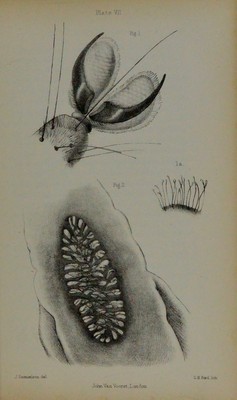
![that the central trunk gives out numerous branches, which convey the blood to the different members of the body. Intimately connected with the circulating system is that of respiration] and when you consider that the Fly is formed to be a denizen of the atmosphere, and that its specific gravity is necessarily one of the most important features in connexion with its exist- ence, you -nill not be surprised to hear that the appa- ratus by which the air is admitted and allowed to circulate through the body, is very beautiful, and displays marked evidences of a designing hand. If you examine the under surface of the Fly with a pocket-lens, you Avill find extending along the middle of the abdomen a membranous band that divides the horny rings of which the covering is composed into two parts, and at each side of this membranous divi- sion (but on the rings themselves) you will perceive a row of minute punctures which penetrate the so-called chitine integument of the body. These little aper- tures, a pair of which is situated upon each abdominal ring, and two pairs upon the thorax, in contiguity with the members, have been variously denominated spiracles, stigmata, or breathing-holes, and through them the air is admitted into the body; the respira- tory operation is effected in a somewhat similar manner to the same process in the higher animals, namely by muscular dilatation and contraction, in this case of the abdominal region. Through the spiracles, which we shall find to be](https://iiif.wellcomecollection.org/image/b28084871_0083.jp2/full/800%2C/0/default.jpg)