Mayne's medical vocabulary : being an explanation of all terms ... / R.G. Mayne.
- Mayne, R. G. (Robert Gray), 1808-1868.
- Date:
- 1889
Licence: Public Domain Mark
Credit: Mayne's medical vocabulary : being an explanation of all terms ... / R.G. Mayne. Source: Wellcome Collection.
Provider: This material has been provided by University of Bristol Library. The original may be consulted at University of Bristol Library.
158/496 page 146
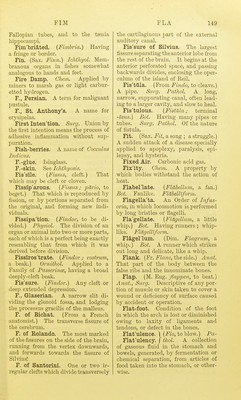
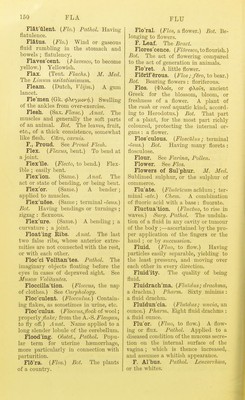
![Fascic'ular. {Fasciculus.) Bot. Buudled together ; clustered ; applied to roots. Fascic'ulate. (Fasciculus.) AnaL, Bot. Buudled together ; clustered. Fascic'tllus. (Dim. Fascis, a bundle.) Bot. Any close bundle of flowers ou little stalks variously inserted, and level at the top. Fharm. A handful, as of flowers, leaves, roots. Anat. A bundle of fibres, chiefly applied to nerve structures. Fas'ciolate. (Same.) Collected into a small bundle. Fastid'ium Cibi. Med. Loathing of foo<l. See Anorexia, Asitia. Fastig'iate. {Fastujinm, the top.) Bot. Applied to nmbelliferous flowers which rise together to the same height, forming a flat top. Fat. (Sax.) A compound of glycerine with fatty acids. See Adeps, Axuncjia, Finguedo, Sevum. F., Em'bolism. See Embolism. Fatty Degenera'tion. The replace- ment of any tissue or organ by fat or oily ]3articles. Fatu'ity. (Fittuus, silly.) Weak- ness of understanding, or idiotcy. Fau'ces. Anat. The cavity observ- able at the back of the mouth, from which the i^harynx and larynx de- scend. Fault. (Fr. Faute, an error.) 6eol. A comjilete fracture of the mass of strata along a vertical or in- clined plane, parallel to which the beds ou one side are uplifted, and on the other depressed : a slip. Fau'na. [Faunus, god of agricul- ture.) Zoiil. A term applied to the animals that live in one country ; applied as a title to works on Natural History. Faure's Battery. See Battery. Faux. («I>dco, to speak.) A7iat. The gorge or mouth. See Fauces. Bot. Applied, by analogy, to the open- ing of the tube of a nionopetalons corolla. Fftvose. {Fdvus; terminal -usus.) Bot., Pathol. Belonging to or like a honeycomb. Fav'us. (Lat. a honeycomb.) A contagious disease of the skin due to the presence of a vegetable para-site {Acho- rion Schimleinii), and characterised by pustules : also called tinea favosa. A honeycomb. Having a cellular scab like a honeycomb. Feath'er. (Sax. Feoder, a plume.) Feathers are the structures which form the covering of birds. They consist of a quill jirolonged into the .shaft, from which lateral exiiansions spring. These may be simple or com- pound. Febric'iila. (Dim. Febris.) Pathol. A slight fever. Fe'brifuge. (Febris; fSgo, to drive away.) Pharm. Having the j)roperty of moderating or abating the violence of fevers. Fe'brile. (Febris.) Pathol. Be- longing to fever ; feverish. Fe'bris. (Ferveo,tohehot) Pathol. A fever. See Fever. Fe'ces. See Faces. Fe'cula. See Fcecula. Fecunda'tion. (Foicundo, to make fruitful.) Bot. The action of the pollen on the ovule, which thereby becomes impregnated. Physiol. The act of impregnating ; also, the state of being impregnated. Fecund'ity. The faculty of repro- duction. Feeling. See Touch. Feet, Distor'tion of. See Tcdipes. Fehling's Test for Sugar. (From a German chenust.) A solution of cupric sulphate 40 grammes, in distilled water 200 cc, is mixed with a solution of potassium tartrate 160 grammes, and sodium hydrate 130 grammes. All made up to a litre with distilled water and boiled for a few minutes. 100 grs. of this solution is equivalent to half a gr. of grape sugar, which, when added, causes the solution to lose its blue colour and the red sub-oxide of copper to fall. Fel Bo'vinum Purifica'tum. (Fcl, bile.) Pharm. Purified ox-gall. Used as a tonic, laxative, etc., in cases where the bile seems deficient. Fellic'tUus. (i'e/, gall.) Anat. The gall-bladder.](https://iiif.wellcomecollection.org/image/b21439849_0158.jp2/full/800%2C/0/default.jpg)
 No text description is available for this image
 No text description is available for this image
 No text description is available for this image