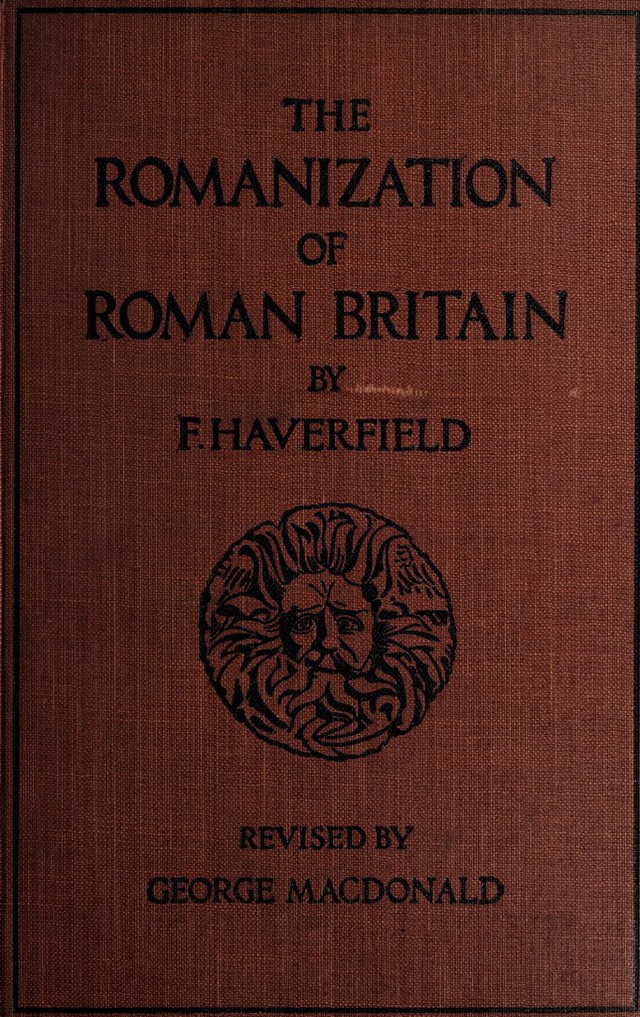
The Romanization of Roman Britain / by F. Haverfield.
- Francis J. Haverfield
- Date:
- 1923
Licence: Public Domain Mark
Credit: The Romanization of Roman Britain / by F. Haverfield. Source: Wellcome Collection.
18/118 page 12
![a remarkable praise of Rome. She (he sang) alone of con¬ querors had taken to her bosom the world which she had subdued ; she had been mother, not mistress, and to her men owed it that from Rhone to Orontes—from the Atlantic to the sands of the Arabian desert—they were all one people.1 Claudian was probably echoing here an earlier Greek littera¬ teur. But that neither makes him insincere nor his words untrue. He felt, and felt rightly, that Romanization was a real thing. The Empire had passed out beyond the nar¬ rower ideal of military dominion, which at its birth Vergil had set forth in famous verses.2 Rulers and ruled had assimilated,; a civilized life had grown up which even its barbarian assailants learnt to honour and accept and which they passed on to later ages. This Romanization was real. But it was, necessarily, not altogether uniform and monotonous throughout all the wide Roman lands. Its methods of development and its fruits varied with local conditions, with racial and geographical differences. It had its limits and its characteristics. First, in respect of place. Not only in the further east, where (as in Egypt) mankind was non-European, but even in the nearer east, where an ancient Greek civilization reigned, the effect of Romanization was inevitably small. Closely as Greek civilization resembled Roman, easy as the transition might seem from the one to the other, Rome met here that most serious of all obstacles to union, a race whose thoughts and affections and traditions had crystallized into definite cohe¬ rent form. That has in all ages checked Imperial assimila¬ tion ; it was the decisive hindrance to the full Romanization of the Greek east. A few Italian oases were created by the establishment of coloniae here and there in Asia Minor and in Syria. Such, for example, were Alexandria Troas, close by ancient Troy, or Antioch in Pisidia, explored in 1912-13 1 Quod, cuncti gens una sumus, Claudian, de cons. Stilichonis, iii. 150-9. The idea seems taken from Aelius Aristides, who in his ‘ Praise of Rome ’ called her ttclvtwv prjTr]p and speaks of the Empire as pea x^Pa vwexv5 KaL *v <pv\ov: he wrote in the middle of the second century. 2 Aen. vi. 847 foil, tu regere imperio populos, etc. See Some Roman Conceptions of Empire (Occasional Publications of the Classical Associa¬ tion, No. 4), 10 ff.](https://iiif.wellcomecollection.org/image/b3135046x_0018.jp2/full/800%2C/0/default.jpg)




 No text description is available for this image
 No text description is available for this image
 No text description is available for this image