[Report 1947] / School Medical Officer of Health, Manchester.
- Manchester (England). Council.
- Date:
- 1947
Licence: Attribution 4.0 International (CC BY 4.0)
Credit: [Report 1947] / School Medical Officer of Health, Manchester. Source: Wellcome Collection.
18/68 page 18
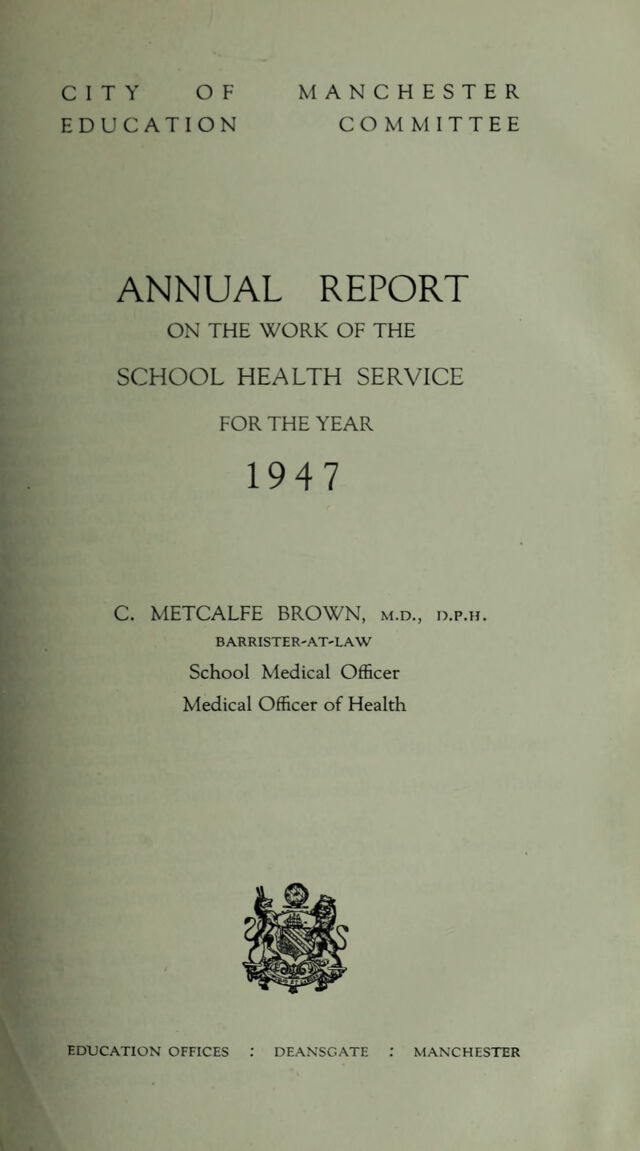
![Defective Vision The scheme for the treatment of children suffering from visual defect and squint includes the yearly re-examination of all previous cases and the testing of new ones. The total number of children, therefore, who require yearly attention for defective eyesight is approximately 15,000. At the commencement of each calendar year the Assistant School Medical Officers, who undertake refraction work, examine all the eye records and indicate those cases they wish to re-examine themselves and those which need only be subjected to a reading test by the clinic nurse. Children who have worn spectacles for a period of twelve months are notified to come to the clinic, and those whose vision shows deterioration as compared with the reading of the previous year, are submitted to the Assistant School Medical Officer for re-examina- tion. The records of the remainder are filed for a further period of twelve months, when the same procedure is repeated. All children wearing spectacles are seen in school every month by the visiting Nurse, who makes a report on her findings. In this way children whose spectacles have a cracked lens, a broken frame or a frame which has become too small on account of the child’s growth, are referred to the clinic for urgent attention or are followed up by the nurse until the condition has been rectified. The co-operation of the teachers is also obtained to ensure that children provided with specta cles wear them regularly in class. The shortage of Assistant School Medical Officers qualified ti prescribe spectacles has made it more difficult to keep pace each yea with the amount of refraction work required. Ultra-Violet Ray Therapy Ultra-violet ray therapy is available at two of the general school clinics, in addition to the installations at the Orthopaedic Clinic, thJ Day Open-Air School and the Day Special School for CrippledJ Children. At the school clinic in the south of the City, treatment is giveJ during the morning sessions, and during the afternoon sessions in thi clinic situated on the north side. At each clinic the treatment i| under the supervision of an Assistant School Medical Officer. The following table shows the conditions for which children werj treated during the year and the numbers in the various classification;! The cases discharged and placed under the heading “ Stationary i are those which failed to continue the treatment, and the numbers ai] placed in this column purely from a statistical point of view. Still under Treatment Discharged Disease or defect December 31st Improving Stationary Improved Statio Bronchitis and Catarrh . . . . 14 32 138 55 Anaemia and Debility . . 25 37 221 62 Subnormal Nutrition .. 3 4 39 16 Rheumatism . . — 3 8 2 Heart Conditions 1 — 1 — Chorea — — 4 —](https://iiif.wellcomecollection.org/image/b29927833_0018.jp2/full/800%2C/0/default.jpg)