[Report 1947] / School Medical Officer of Health, Manchester.
- Manchester (England). Council.
- Date:
- 1947
Licence: Attribution 4.0 International (CC BY 4.0)
Credit: [Report 1947] / School Medical Officer of Health, Manchester. Source: Wellcome Collection.
30/68 page 30
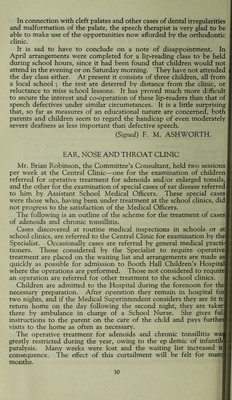
![In connection with cleft palates and other cases of dental irregularities and malformation of the palate, the speech therapist is very glad to be able to make use of the opportunities now afforded by the orthodontic clinic. It is sad to have to conclude on a note of disappointment. In April arrangements were completed for a lip-reading class to be held during school hours, since it had been found that children would not attend in the evening or on Saturday morning. They have not attended the day class either. At present it consists of three children, all from a local school ; the rest are deterred by distance from the clinic, or reluctance to miss school lessons. It has proved much more difficult to secure the interest and co-operation of these lip-readers than that of speech defectives under similar circumstances. It is a little surprising that, so far as measures of an educational nature are concerned, both parents and children seem to regard the handicap of even moderately severe deafness as less important than defective speech. (Signed) F. M. ASHWORTH. EAR, NOSE AND THROAT CLINIC Mr. Brian Robinson, the Committee’s Consultant, held two sessions per week at the Central Clinic—one for the examination of children referred for operative treatment for adenoids and/or enlarged tonsils, and the other for the examination of special cases of ear disease referred to him by Assistant School Medical Officers. These special cases were those who, having been under treatment at the school clinics, did not progress to the satisfaction of the Medical Officers. The following is an outline of the scheme for the treatment of cases'] of adenoids and chronic tonsillitis. Cases discovered at routine medical inspections in schools or at] school clinics, are referred to the Central Clinic for examination by the] Specialist. Occasionally cases are referred by general medical practi¬ tioners. Those considered by the Specialist to require operative] treatment are placed on the waiting list and arrangements are made a; quickly as possible for admission to Booth Hall Children’s Hospital] where the operations are performed. Those not considered to requir( an operation are referred for other treatment to the school clinics. Children are admitted to the Hospital during the forenoon for th( necessary preparation. After operation they remain in hospital foij two nights, and if the Medical Superintendent considers they are fit tc return home on the day following the second night, they are taker there by ambulance in charge of a School Nurse. She gives full instructions to the parent on the care of the child and pays furtheij visits to the home as often as necessary. The operative treatment for adenoids and chronic tonsillitis wa! greatly restricted during the year, owing to the ep demic of infantile paralysis. Many weeks were lost and the waiting list increased ir consequence. The effect of this curtailment will be felt for man's] months.](https://iiif.wellcomecollection.org/image/b29927833_0030.jp2/full/800%2C/0/default.jpg)