[Report 1947] / School Medical Officer of Health, Manchester.
- Manchester (England). Council.
- Date:
- 1947
Licence: Attribution 4.0 International (CC BY 4.0)
Credit: [Report 1947] / School Medical Officer of Health, Manchester. Source: Wellcome Collection.
37/68 page 37
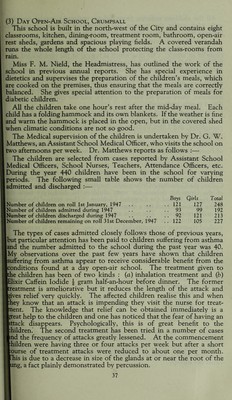
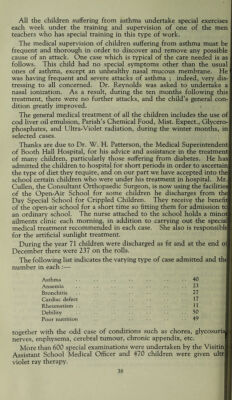
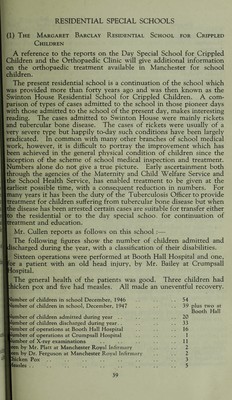
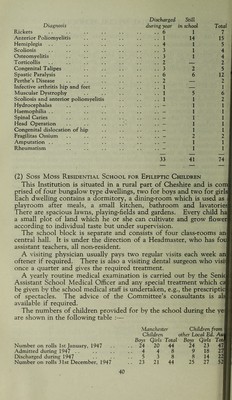
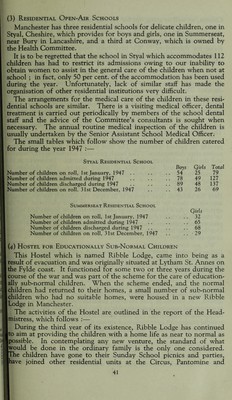
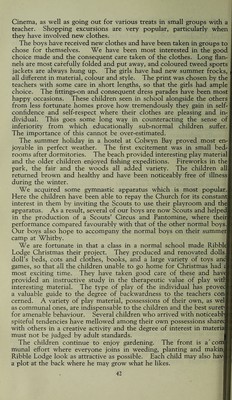
![(3) Day Open-Air School, Crumpsall TTiis school is built in the north-west of the City and contains eight classrooms, kitchen, dining-room, treatment room, bathroom, open-air rest sheds, gardens and spacious playing fields. A covered verandah runs the whole length of the school protecting the class-rooms from rain. Miss F. M. Nield, the Headmistress, has outlined the work of the school in previous annual reports. She has special experience in dietetics and supervises the preparation of the children’s meals, which are cooked on the premises, thus ensuring that the meals are correctly balanced. She gives special attention to the preparation of meals for diabetic children. All the children take one hour’s rest after the mid-day meal. Each child has a folding hammock and its own blankets. If the weather is fine and warm the hammock is placed in the open, but in the covered shed when climatic conditions are not so good. The Medical supervision of the children is undertaken by Dr. G. W. Matthews, an Assistant School Medical Officer, who visits the school on two afternoons per week. Dr. Matthews reports as follows ;— The children are selected from cases reported by Assistant School Medical Officers, School Nurses, Teachers, Attendance Officers, etc. During the year 440 children have been in the school for varying [periods. The following small table shows the number of children admitted and discharged :— [Number of children on roll 1st January, 1947 [Number of children admitted during 1947 [Number of children discharged during 1947 [Number of children remaining on roll 31st December, 1947 The types of cases admitted closely follows those of previous years, [but particular attention has been paid to children suffering from asthma land the number admitted to the school during the past year was 40. ]My observations over the past few years have shown that children iffering from asthma appear to receive considerable benefit from the conditions found at a day open-air school. The treatment given to le children has been of two kinds : (a) inhalation treatment and (b) ^ixir Caffein Iodide | gram half-an-hour before dinner. The former reatment is ameliorative but it reduces the length of the attack and Jves relief very quickly. The affected children realise this and when fhey know that an attack is impending they visit the nurse for treat- tent. The knowledge that relief can be obtained immediately is a teat help to the children and one has noticed that the fear of having an kttack disappears. Psychologically, this is of great benefit to the children. The second treatment has been tried in a number of cases md the frequency of attacks greatly lessened. At the commencement pildren were having three or four attacks per week but after a short purse of treatment attacks were reduced to about one per month, lis is due to a decrease in size of the glands at or near the root of the Jng, a fact plainly demonstrated by percussion. Boys Qirls Total 121 127 248 93 99 192 92 121 213 122 105 227](https://iiif.wellcomecollection.org/image/b29927833_0037.jp2/full/800%2C/0/default.jpg)