The medical background of Anglo-Saxon England : a study in history, psychology, and folklore / [Wilfrid Bonser].
- Wilfrid Bonser
- Date:
- 1963
Licence: Attribution-NonCommercial 4.0 International (CC BY-NC 4.0)
Credit: The medical background of Anglo-Saxon England : a study in history, psychology, and folklore / [Wilfrid Bonser]. Source: Wellcome Collection.
444/492 (page 404)
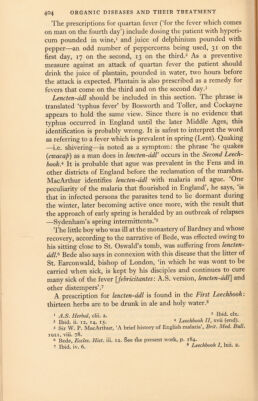
![The prescriptions for quartan fever (‘for the fever which comes on man on the fourth day’) include dosing the patient with hyperi- cum pounded in wine, 1 and juice of delphinium pounded with pepper—an odd number of peppercorns being used, 31 on the first day, 17 on the second, 13 on the third. 2 As a preventive measure against an attack of quartan fever the patient should drink the juice of plantain, pounded in water, two hours before the attack is expected. Plantain is also prescribed as a remedy for fevers that come on the third and on the second day. 3 Lencten-ddl should be included in this section. The phrase is translated ‘typhus fever’ by Bosworth and Toller, and Cockayne appears to hold the same view. Since there is no evidence that typhus occurred in England until the later Middle Ages, this identification is probably wrong. It is safest to interpret the word as referring to a fever which is prevalent in spring (Lent). Quaking —i.e. shivering—is noted as a symptom: the phrase ‘he quakes (cwacap) as a man does in lencten-ddl’ occurs in the Second Leech- bookA It is probable that ague was prevalent in the Fens and in other districts of England before the reclamation of the marshes. MacArthur identifies lencten-ddl with malaria and ague. ‘One peculiarity of the malaria that flourished in England’, he says, ‘is that in infected persons the parasites tend to lie dormant during the winter, later becoming active once more, with the result that the approach of early spring is heralded by an outbreak of relapses —Sydenham’s spring intermittents.’ 5 The little boy who was ill at the monastery of Bardney and whose recovery, according to the narrative of Bede, was effected owing to his sitting close to St. Oswald’s tomb, was suffering from lencten- ddlA Bede also says in connexion with this disease that the litter of St. Earconwald, bishop of London, ‘in which he was wont to be carried when sick, is kept by his disciples and continues to cure many sick of the fever [ febricitantes : A.S. version, lencten-ddl] and other distempers’. 7 A prescription for lencten-ddl is found in the First Leechbook : thirteen herbs are to be drunk in ale and holy water. 8 1 A.S. Herbal , dii. 2. 2 Ibid. dx. 3 Ibid. ii. 12, 14, 15. 4 Leechbook II, xvii (end). 5 Sir W. P. MacArthur, ‘A brief history of English malaria’, Brit. Med. Bull. 1951, viii. 78. 6 Bede, Eccles. Hist. iii. 12. See the present work, p. 184. 7 Ibid. iv. 6. 8 Leechbook I, lxii. 2.](https://iiif.wellcomecollection.org/image/b20086258_0442.JP2/full/800%2C/0/default.jpg)