The theory of ocular defects and of spectacles / translated from the German of Hermann Scheffler by Robert Brudenell Carter with prefatory notes and a chapter of practical instructions.
- Hermann Scheffler
- Date:
- 1869
Licence: Public Domain Mark
Credit: The theory of ocular defects and of spectacles / translated from the German of Hermann Scheffler by Robert Brudenell Carter with prefatory notes and a chapter of practical instructions. Source: Wellcome Collection.
Provider: This material has been provided by The Royal College of Surgeons of England. The original may be consulted at The Royal College of Surgeons of England.
114/266 page 92
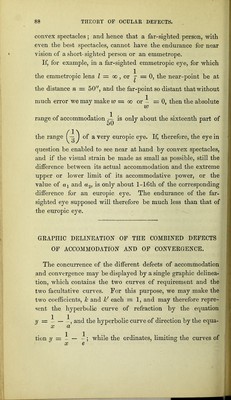
![the disproportion does not exceed a certain degree, the pair of eyes will see clearly and singly, but with strain. When this certain degree is exceeded, either one or the other function will no longer be discharged ; and there will be either single vision with an imperfect image, or double vision with clear images, so long as the apparatus, still in activity, does not reach the absolute limit of its power. To what degree an eye can bear this visual strain between accommodation and convergence, for the different degrees of each, that is, between what limits, for a given convergence, the accommodation can be raised above, or lowered below, the normal standard, or between what limits, for a given accommo- dation, the convergence may be increased or diminished, might be expressed after a series of observations, in the form of a general law, which, in particular cases, would be more or less modified by individual conditions. I believe that such an average of the relative accommodation and convergence limits would lead to the result, when y is a given convergence, and therefore the ordinate of the hyperbolic convergence curve for a definite convergence distance x, that the limits of accommoda- tion with visual strain may be shown by two ordinates of the 1 values w and —, and that the coefficient m will, for all values \ m of y, be nearly constant. If, for example, we find that for! any given convergence the normal accommodation may, with] 1 7 strain, be increased by one-sixth; so that m ’ 1 + 7T — X i 6 6’ then the accommodation may, for any convergence, range from 7 , 6 t; 2/ to - y. 6 7 If this supposition were confirmed, the limits of the relative! accommodation would be shown by two equilateral hyperbolas] of which one, with the ordinates m y, would be above the re-1 quirement curve of the convergence, while the other, with the* ordinates -, would be below it. m tive convergence would be shown by two similar hyperbolas,^ Inversely, the limits of rela-](https://iiif.wellcomecollection.org/image/b2236397x_0116.jp2/full/800%2C/0/default.jpg)