Content advisory
This digitised material is free to access, but contains information or visuals that may:
- include personal details of living individuals
- be upsetting or distressing
- be explicit or graphic
- include objects and images of objects decontextualised in a way that is offensive to the originating culture.
Licence: In copyright
Credit: Dissertation in Draft: Chapter IV. Source: Wellcome Collection.
5/11
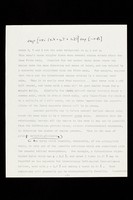
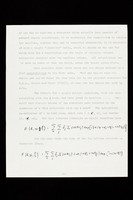
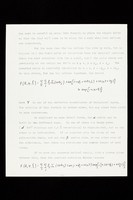
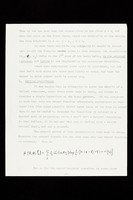
![One must be careful in usinr this formula to place the single helix so that the diad wiU come to he along the x axis when both helices are considered. Por the case vhen the two helices lie side by side, 1 et us suppose that the first helix is trpns 1 ated from its original position «• m (when its axis coincides with the z axis), unt^ : l the point which was previously at the origin now fails on x = o, y = y Q , z = z Q . The inverted helix is similarly translated to x = o, y = -y Q , z = -z 0 « We then obtain, for the tv,o helices together, the result here Y is one of the cartesian co-ordinates of reciprocal space. The notation of this formula is rather mixed, hut any other form would he more cumbersome. As explained in more detail later, the ot -helix can be built in two different ways. In one of these the basic screw ( oA 100° rotation and 1.5 5 translation) is right-handed, and in the other it is left-handed. If ve consider only the atoms of the polypeptide chain, and not the /3 carbon atom, or any other atorr. of the side-chain, then these tv. o structures are mirror images of each other. If we have two separate helical chains, with a mirror plane between them, then the combined structure factor becomes f iß, y ,I ) : 254 xc 27itlr i)i- * ^] ~ j](https://iiif.wellcomecollection.org/image/b18185794_PP_CRI_F_1_4_0005.jp2/full/800%2C/0/default.jpg)