Medical diagnosis : with special reference to practical medicine. A guide to the knowledge and discrimination of diseases / By J. M. Da Costa ... Illustrated with engravings on wood.
- Jacob Mendes Da Costa
- Date:
- 1895
Licence: Public Domain Mark
Credit: Medical diagnosis : with special reference to practical medicine. A guide to the knowledge and discrimination of diseases / By J. M. Da Costa ... Illustrated with engravings on wood. Source: Wellcome Collection.
Provider: This material has been provided by The University of Leeds Library. The original may be consulted at The University of Leeds Library.
961/1004
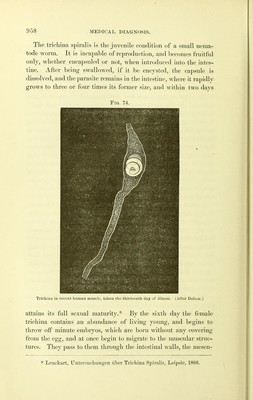
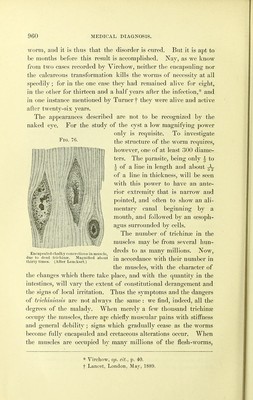
![same patient, occasioning great annoyance and distress, even fatal exhaustion; but it is stated that there is often only one present. The number may vary between this and iifty. Some worms are twelve, others forty inches long, or even more. According to Busk, the parasite grows in the human areolar tissue at the rate of about an inch a week. Though it is most frequently found in the lower extremities, it has been observed to appear in the socket of the eye, in the mouth, the cheeks, the ears, and under the tongue and the scalp. It migrates rapidly from one part of the body to another. Where it exists, a pricking or an itching heat is felt; a vesicle forms when the worm is about coming to the surface, and this vesicle opens, leaving an angry-looking ulcer, in the, centre of which the parasite shows itself. Phlegmonous spots may appear all over the body in which specimens of dra- cunculus are found.* The period of incubation is from eight to twelve months: a year often elapses before the Guinea-worm makes itself manifest in the human body.f The disorder, com- mon in Asia and in Africa, is, fortunately, one with which we are unacquainted. Trichina spiralis.—This parasite was discovered by Owen in 1835 in human muscles taken from the dissecting-room; it was subsequently found by Leidy in the animal which it most infests, the pig; but it was not looked vipon as other than harmless until in 1860 Zenker proved that trichinse may exist free in the muscles of man, that they are encapsuled only after some time, and that they are the cause of a very serious disease,—so serious that whole families have perished from its effects amid great suffer- ing, and that, for instance, in the small village of Hadersleben, of two thousand inhabitants, three hundred were affected, of whom eighty died.;]; The parasite is always introduced into the body by eating ham, pork, or sausages made from the flesh of pigs containing trichinfe. It is very probable that the hogs themselves obtain them from rats, in which they are common. It has also been stated that trichinse may exist in beef; but this is not generally admitted. * Woskresensky, quoted in Sajous's Annual, vol. i., 1889. f Aitken's Practice of Medicine, vol. i. { Virchow, Die Lehre von den Trichinen, p. 83.](https://iiif.wellcomecollection.org/image/b21508872_0961.jp2/full/800%2C/0/default.jpg)