Report on the nature and import of certain microscopic bodies found in the intestinal discharges of cholera : presented to the Cholera Committee of the Royal College of Physicians of London ,by their sub-committee, on the 17th October, 1849.
- Date:
- 1849
Licence: Public Domain Mark
Credit: Report on the nature and import of certain microscopic bodies found in the intestinal discharges of cholera : presented to the Cholera Committee of the Royal College of Physicians of London ,by their sub-committee, on the 17th October, 1849. Source: Wellcome Collection.
Provider: This material has been provided by The University of Glasgow Library. The original may be consulted at The University of Glasgow Library.
20/37 page 14
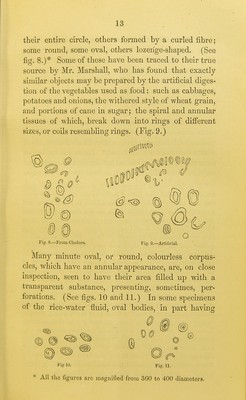
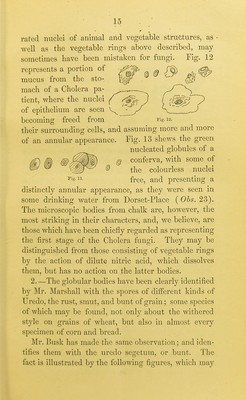
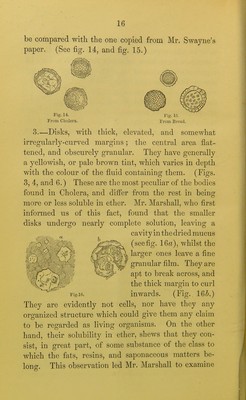
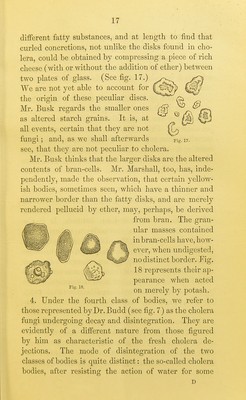
![■ their middle filled up as here described, and, in part, mere rings, exist in extraordinary abundance. The rings of these bodies have been observed, by Mr. Busk and Dr. Griffith, to be divided, by cross-lines, into segments, which Mr. Busk thinks are bead-shaped: an appearance which had occasionally been noticed by ourselves, as well as by Mr. Marshall. (See fig. 11.) They are calcareous structures, originally derived from chalk, in which they abound; and they have been introduced into the contents of the intestines with the medicines (chalk-mixture, aromatic confection, &c.) which the patients have taken.* These minute bodies from the chalk are, of course, not found in all cases; and we think it not unlikely that, in their absence, the sepa- * It is right to state how we arrived at the knowledge of these facts. Dr. Griffith had pointed out to us that the bodies in ques- tion are heavy, polarize light, are soluble in dilute nitric and muriatic acid, without effervescence, are not destroyed by incine- ration and are unaffected by iodine or potash. Hence there was no doubt as to their inorganic nature. He believed that they were oxalate or phosphate of lime. Mr. Marshall subse- quently shewed us that acetic acid also dissolves them readily, and that sulphuric acid acts on them, producing needles of sulphate of lime. Having ourselves found the same bodies in the evacuations of two patients suffering from typhoid fever, we were examining them in company with Dr. Griffith and Mr. Marshall, when the demonstration of their calcareous nature reminded us of the fact, that these patients had been taking medicine containing chalk, and, at the same time, brought to our recollection the remark made to one of us by Mr. Topping, that ]\Ir. Brittan's annular bodies were to be found in chalk-mixture. Accordingly, we examined a portion of medicine containing aro- matic confection, and, afterwards, a piece of common chalk, and, in both, found the bodies described above, though not the larger disks which are also found in the rice-water fluid. Ehrenberg figures these calcareous bodies, and describes them as being crys- talloids. Abh. d Akad. d. Wiss. z. Berl. 1838. p. 68.](https://iiif.wellcomecollection.org/image/b21470625_0020.jp2/full/800%2C/0/default.jpg)