Licence: Public Domain Mark
Credit: Annual sanitary report of the Province of Assam. Source: Wellcome Collection.
20/48 page 10
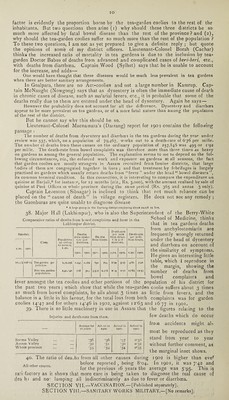
![IO factor is evidently the proportion borne by the tea-garden coolies to the rest of the inhabitants. But two questions then arise (i) why should these three districts be so much more affected by fatal bowel disease than the rest of the province ? and (2), why should the tea-garden coolies suffer so much more than the rest of the population ? To these two questions, I am not as yet prepared to give a definite reply ; but quote the opinions of some of my district officers. Lieutenant-Colonel Borah (Cachar) thinks the increased ratio of mortality in tea gardens is due to the inclusion by tea- garden Doctor Babus of deaths from advanced and complicated cases of beri-beri, etc., with deaths from diarrhoea. Captain Wood (Sylhet) says that he is unable to account for the increase, and adds—• One would have thought that these diseases would be much less prevalent in tea gardens when there are better sanitary arrangements. In Goalpara, there are no Act-coolies and not a large number in Kamrup. Cap¬ tain McNaught (Nowgong) says that as dysentery is often the immediate cause of death in chronic cases of disease, such as malarial fevers, etc., it is probable that some of the deaths really due to them are entered under the head of dysentery. Again he says — However the probability does not account for all the difference. Dysentery and diarrhcea appear to be more prevalent on tea gardens, or of a more fatal nature than among the population of the rest of the district. But he cannot say why this should be so. Lieutenant-Colonel Macnarnara’s (Dairang) report for 1902 contains the following passage : The number of deaths from dysentery and diarrhoei in the tea gardens during the year under review was 537, which, on a population of 79,467, works out to a death-rate of 676 per rnille. The number of deaths from these causes on the ordinary population of 257,846 was 495 or i‘92 per mille. The death-rate from bowel complaints was therefore more than three times as heavy on gardens as among the general population. The explanation seems to me to depend on the fol¬ lowing circumstances, viz., the enforced work and exposure on gardens at all seasons, the fact that garden coolies are mostly strangers in Assam recruited from famine districts, that large bodies of them are congregated together in lines ; and that treatment by febrifuges is largely practised on gardens which usually return deaths from “fever” under the head f< bowel diseases, its common terminal condition. In this connection, it is interesting to compare the expenditure on quinine at Barjuli,* for instance, for 12 months {viz., Rs. 3,000), with the amount realised by sale of quinine at Post Offices in whole province during the same period (Rs. 365 and annas 3 only), Captain Le/enton (Sibsagar) is inclined to think that not much reliance can be placed on the “ cause of death ” in village registers. He does not see any remedy ; the Gaonburas are quite unable to diagnose disease * A large group in the Darrang district employing about 10,078 co lies. 38. Major Hall (Lakhirnpur), who is also the Superintendent of the Berry-White Comparative ratios of deaths from b nvel complaints and fever in the School of Medicine, thinks Lakhimpur district. that in tea gardens deaths from anchylostomiafis are frequently wrongly returned under the head of dysentery and diarrhoea on account of the similarity of symptoms. He gives an interesting little table, which 1 reproduce in the margin, showing the number of deaths from bowel complaints and fever amongst the tea coolies and other portions of the population of his district for the past two years ; which show that while the tea-garden coolie suffers about 3 times as much from bowel complaints, he ails about 3 times as little from fevers, and the balance is a little in his favour, for the total loss from both complaints was for garden coolies I4’47 and f°r others I4'46 in 1902, against I2'63 and 16 77 in 1901. 39. There is so little machinery in use ip Assam that the figures relaiing to the few deaths which do occur Rainfall. Class. Population according to census. 1 ,ot. Deaths from dysen¬ tery and diarrhoea. De >ths from fevers. D-ath-rate per mile from dysen- t ry aud diarrhoea. Death-rate per mille from fevers. i;oi. 1902. 1991. I902. 1901. (903, 1901. 1902. i;ox-f 1902. «o;-73 128'03 Tea-garden po- 1,30,256 1,043 1,182 600 704 8'oj 9-07 4‘6i 5'4° pulalijn. Non tea-garden 2,41,’4° 708 5°J 3.336 3,9*8 »’?4 2-JI I3‘8 3 13-35 population. Injuries and death-rate from them. — Average for 16 years. Actual in 1900. Actual in 1901. Actual in 1902. Surma Valley •36 •36 •37 0-3* Assam Valley •30 ■31 •30 0-32 Whole province •33 •34 •34 o*35 from accidents might al¬ most be reproduced as they stand from year to year without further comment, as the marginal inset shows. The ratio of deaths from all other causes during 1902 is higher than ever 40 All other causes. before reported , being 8*04. In 1901, it was 7*42 and for the previous \6 years the average was 5'95. This i§ satisfactory as it shows that more care is being taken to diagnose the real cause of dea h; and not lumping all indiscriminately as due to fever or diarrhoea. SECTION VII.—VACCINATION.— [Published separately]. SECTION VIII.—SANITARY WORKS MILITARY.—[No remarks].](https://iiif.wellcomecollection.org/image/b31495497_0020.jp2/full/800%2C/0/default.jpg)



 No text description is available for this image
 No text description is available for this image
 No text description is available for this image