The treatment of fractures : some practical points / James P. Warbasse.
- James Peter Warbasse
- Date:
- 1909
Licence: In copyright
Credit: The treatment of fractures : some practical points / James P. Warbasse. Source: Wellcome Collection.
Provider: This material has been provided by The Royal College of Surgeons of England. The original may be consulted at The Royal College of Surgeons of England.
4/12 page 4
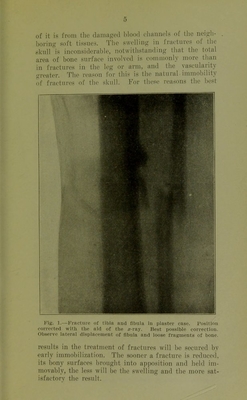
![tlio newer and more dramatic branches of abdominal sur^^ery are more nearly perfected than is the surgerv of fractures, which has occupied therapeutic ingenuity from a time antedating recorded history. The surgeon does \v;isely to think of a fracture as a wound—a wound of hone—which in its treatment and healing is amenable to the same rules tliat govern tlie healing of wounds in other parts of the body. The more widely the wound surfaces are separated the greater is the damage to the blood and lymph chan- nels and to the nerves. The more mobility there is the ofreater Avill be exudate and swellinsf. Con- *• o versely the sooner and more accurately the wound sur- faces are brought together and retained in apposition the less will be the swelling and the more perfect the healing. We have not only to think of the wounded bone, but of the structures which lie in relation to it. The mus- cles play an important role, but muscular resistance is often regarded as the obstacle to reduction when the trouble is due really to the interposition between the bone ends of fascia, of a bundle of muscle, of a clot, or of periosteal tissue, which the .r-ray does not reveal. When manipulation does not force such fractures from their entanglements, a satisfactory result is best secured by operation. Unless operated on these fractures are the ones which give delayed union or non-union. There is much misconception of this question of non- union. Students are taught much about constitutional weakness, old age. and lack of earthy salts in the blood; but these, in my judgment, are insignificant. The vast majority of eases of non-union are due to the conditions just narrated. Given broken bone surfaces held in close apposition, bone to bone, and they will grow together, just as they do in fractures of the skull; but let soft tissues be interposed and the patient is a candidate for the so-ealled non-union—and a diet of oyster shells and parlor matches will not alter the ease. Swelling is another important consideration. Tt is due to exudation,. ], from the wounded bone surfaces and. 2, from the surroundinrr soft tissues which are in- jured by bone fragments or by loss of support. We may put it down ns a pretty general rule that this swelling is in direct proportion to the amount of mobility. The exudate from the hone itself amounts to but little. Most](https://iiif.wellcomecollection.org/image/b22413327_0006.jp2/full/800%2C/0/default.jpg)