The clinical history and exact localization of perinephric abscesses / by John B. Roberts.
- John Bingham Roberts
- Date:
- 1883
Licence: Public Domain Mark
Credit: The clinical history and exact localization of perinephric abscesses / by John B. Roberts. Source: Wellcome Collection.
Provider: This material has been provided by The Royal College of Surgeons of England. The original may be consulted at The Royal College of Surgeons of England.
3/22
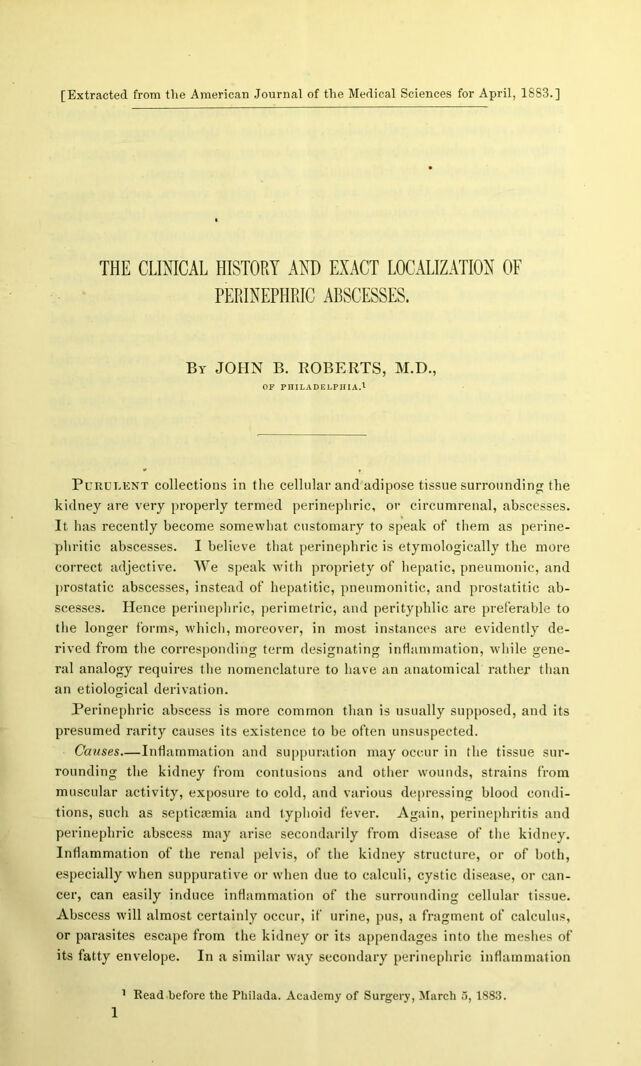
![[Extracted from the American Journal of the Medical Sciences for April, 1883.] THE CLINICAL HISTORY AND EXACT LOCALIZATION OF PERINEPHRIC ABSCESSES. By JOHN B. ROBERTS, M.D., OF PHILADELPHIA.'- PcRUi.KNT collections in the cellular and adipose tissue surrounding the kidney are very [iroperly termed perinephric, or circumrenal, abscesses. It has recently become somewhat customary to speak of them as perine- phritic abscesses. I believe that perinephric is etymologically the more correct adjective. We speak with propriety of hepatic, pneumonic, and jirostatic abscesses, instead of hepatitic, pneumonitic, and prostatitic ab- scesses. Hence perinephric, perimetric, and perityphlic are preferable to tlie longer forms, w'hich, moreover, in most instances are evidently de- rived from the corresponding term designating inflammation, Mdiile gene- ral analogy requires the nomenclature to have an anatomical rather than an etiological derivation. Perinephric abscess is more common than is usually supposed, and its presumed rarity causes its existence to be often unsuspected. Causes—Inflammation and suppuration may occur in the tissue sur- rounding the kidney from contusions and other w'ounds, strains from muscular activity, exposure to cold, and various depressing blood condi- tions, sucli as septicaemia and typhoid fever. Again, perinephritis and perinephric abscess may arise secondarily from disease of the kidney. Inflammation of the renal pelvis, of the kidney structure, or of both, especially when suppurative or when due to calculi, cystic disease, or can- cer, can easily induce inflammation of the surrounding cellular tissue. Abscess will almost certainly occur, if urine, pus, a fragment of calculus, or parasites escape from the kidney or its appendages into tlie meshes of its fatty envelope. In a similar way secondary perinephric inflammation ’ Read before the Philada. Academy of Surgery, March o, 1883.](https://iiif.wellcomecollection.org/image/b22379289_0005.jp2/full/800%2C/0/default.jpg)