Social life in Britain from the conquest to the reformation / compiled by G.G. Coulton.
- George Gordon Coulton
- Date:
- 1918
Licence: Public Domain Mark
Credit: Social life in Britain from the conquest to the reformation / compiled by G.G. Coulton. Source: Wellcome Collection.
69/570 page 47
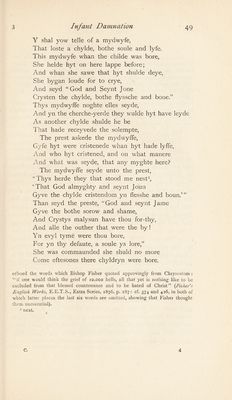
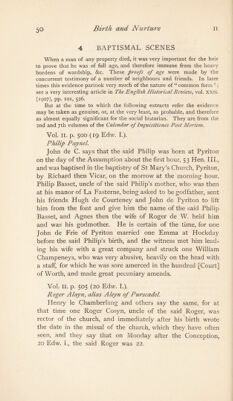
![2 THE FATHER Trevisa’s Bartholomew, Bk VI. cap. 15. The fader is dyligent and besy, and lo[v]yth kindely his chylde, in so moche that he sparyth his owne mete to fede his chyldren. And that is generally forthe in all kynde of beastes, out-take fewe, in whome kynde gothe out of kynde, and therfore they ben not busy and carefulle aboute theyr yonge, but they do beate theym awaye, as Aristotle libro 6. sayeth of the egle, that with his bylle and wynges beate and dryve away theyr yonge. A man loveth his chylde and fedeth and nouryssheth it, and setteth it at his owne borde whan it is wayned. And teacheth hym in his yougthe with speche and wordes, and chasteth hym with betinge, and setteth hym and putteth him to lerne under ward and kepynge of wardens and tutours. And the father sheweth hym no gladde chere, leste he waxe prowde; and he loveth mooste the sonne that is like to hym, and loketh ofte on hym. And gyveth to his chyldren clothynge, meate, and drynke, as theyr age requyreth, and purchaseth londes and herytage for his chyldren, and cesseth not to make it more and more....The more the father loveth his chylde, the more busyly he teacheth and chastyseth hym and holdethe hym the more streyte under chastisynge and loore, and whan the chylde is mooste loved of the father it someth that he loveth hym not: for he betyth and greveth hym ofte, lest he drawe to evyll maners and tatches1, and the more the child is like to the fader, the better the father loveth hym. The fader is ashamed, if he here any foule thing tolde by his chyldren. The fathers herte is sore greved, if his chyldren rebel ayenst him. 3 INFANT DAMNATION R. of Brunne, Handlyng Synne, E.E.T.S., 1901, p. 298, abbreviated. The theory of the damnation of unbaptized infants was not invented by Calvin, but was taught by St Augustine, and whole-heartedly accepted by all orthodox theologians throughout the Middle Ages. Ofte we here the lewed men seye That erre ful moche oute of the weye 1 faults.](https://iiif.wellcomecollection.org/image/b29828624_0071.jp2/full/800%2C/0/default.jpg)
 No text description is available for this image
 No text description is available for this image
 No text description is available for this image