Social life in Britain from the conquest to the reformation / compiled by G.G. Coulton.
- George Gordon Coulton
- Date:
- 1918
Licence: Public Domain Mark
Credit: Social life in Britain from the conquest to the reformation / compiled by G.G. Coulton. Source: Wellcome Collection.
75/570 page 53
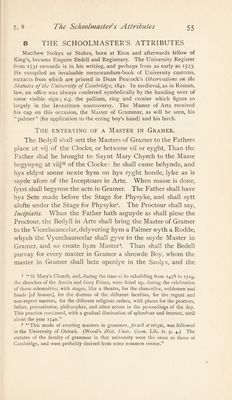
![several of his neighbours were robbed in the forest of Dene, between Gloucester and the abbey of Tynterne. Walter le Deyer says that on that Thursday John le Taverner, of Circestre, came towards his house by the way near the wood of Wetyndon, and met robbers, who killed the said John there, and robbed him of 10/. John le Gurnay says that on the previous Wednesday Sir Richard, vicar of Ledeneye, his brother, was buried. John le Weler says that on the Friday following Elizabeth, his sister, fell into a certain marlpit, within her close near Leyecroft, and broke her neck. Richard Pynnock says that on that Thursday he lifted from the font in the church of Kyngestanleye John, son of William Despenser, who was baptised in the same water in which the said William was baptised. 6 DECAYED SCHOOLS Macaulay, arguing in 1847 before the House of Commons in favour of compulsory state education, had to meet the plea that voluntarism “ will do all that is necessary, if we will only wait with patience.” He retorted u wait with patience! Why, we have been waiting ever since the Hep¬ tarchy.” His allusion was probably to the decree of the council of Cloveshoe in 747 which has sometimes been interpreted as implying a national system of education, though, in fact, it was only an attempt to combat the ignorance prevailing in the majority of monasteries. Though medieval grammar-schools were far more numerous than was supposed before A. F. Leach began his researches, they were always irregularly spaced and their existence was precarious. The best illustration of this may be found in the petition of William Byngham, a London priest, to Llenry VI. in 1439. Byngham begged leave to found at Cambridge a college called “ God’s Blouse,” on the following plea: the whole document is printed in A. F. Leach, Educational Charters and Documents, 1911, p. 402. “The Clergie of this youre Reaume...is like to be empeired and febled by the defaute and lak of Scolemaistres of Gramer, in so moche that [the founder, William Bingham] hath founde in [your] Lande, ouer the est partie of the wey ledyng from [Southampton to Coventre, and so forth no ferther north than Rypon, LXX Scoles voide or mo, that weren occupied all at ones within L yeres passed, whereof as now ben almost none, nor none mowen be hade in your Universitees over those that nedes most ben occupied still there.”](https://iiif.wellcomecollection.org/image/b29828624_0077.jp2/full/800%2C/0/default.jpg)
 No text description is available for this image
 No text description is available for this image
 No text description is available for this image