Content advisory
This digitised material is free to access, but contains information or visuals that may:
- include personal details of living individuals
- be upsetting or distressing
- be explicit or graphic
- include objects and images of objects decontextualised in a way that is offensive to the originating culture.
Licence: In copyright
Credit: "Linking numbers and nucleosomes". Source: Wellcome Collection.
4/24
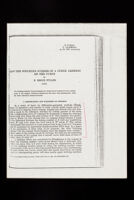
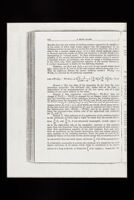
![To Professor G. CÄLUGÄREANU on his 70th anniversary I i ' I ' ■ • '• ' ! i HOW THE WRITHING NUMBER OF A CURVE DEPENDS j ON THE CURVE ** F. BROCK FULLEE (usa) The writhing number (Gauss integral) of a closed curve is shown to vary continu ously ii the tangent directions defined by the curve vary continuously while the total curvature remains bounded. i. intuoductiok am) statement of theorem In a study of knots by differential-geometric methods Cälugä- i reami [1] assigned a real number to every smooth closed simple curve X : by means of a singular Gauss looping integral and showed that this inte- ■ eral is equal to the difference between the linking number of the curve \ with a neighboring curve X* obtained by displacing X along the principal normal and 1/2 ts times the total torsion of X. This equation was genera lized by White [4] who showed that the singular Gauss integral is equal to the difference between the linking number of X with any neighboring carre X* and 1/2 tc times the total twist of X* about X. The author * encountered this equation in a less precise form in the work of J. Yinograd I -md his associates on supercoiled double-stranded DNA rings. In a paper J on the mechanics of these rings [2] he proposed the term writhing \ aumber for the singular Gauss integral, after the English word writhe, I chicli refers to the coiling caused by twisting. We shall use the definitions f *nd notations of [2], except that a smooth curve shall mean of class C 2 f rather than of class 0. A problem which was considered by Cälugäreanu is the manner in I *hich the writhing numbsr varies as the closed curve is deformed. Pro- 5 v ided fhe curve does net cross itself during the deformation, in which ? '•'•■'e the writhing number jumps in value, the writhing number varies 'ntinuously if the curve's first and second derivatives vary continuously, 'a other words two curves whose first and second derivatives are nearly —inai .at corresponding points will have nearly equal writhing numbers. íí v r.OlM. MATH. PURES ET APPI... TOMB XVII. N°». P. 13:# -1334. BUCAREST. 1972](https://iiif.wellcomecollection.org/image/b18179654_PP_CRI_H_6_12_2_0004.jp2/full/800%2C/0/default.jpg)