Content advisory
This digitised material is free to access, but contains information or visuals that may:
- include personal details of living individuals
- be upsetting or distressing
- be explicit or graphic
- include objects and images of objects decontextualised in a way that is offensive to the originating culture.
Licence: In copyright
Credit: "Linking numbers and nucleosomes". Source: Wellcome Collection.
5/24
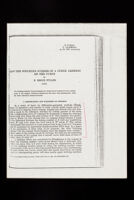
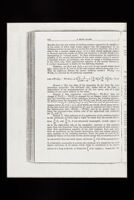
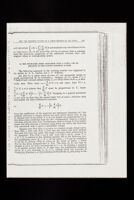
![1330 brock fuller But the fact that the notion of writhing number appears to be significant in the study of DNA rings would suggest that the dependence of the writhing number on the curve is in fact less sensitive than this. For a DNA ring is not a smooth closed curve ; it is a long closed molecule subjeel to thermal agitation inside of which one imagines a, smooth closed curvo representing its central curve. In these circumstances the approximate equality of the second derivatives of two such central curves is scarcely a scientific datum ; nevertheless, one wants to assign a writhing number to the DNA ring. That approximate equality of the second derivatives is in fact unnecessary is shown by the following theorem. Theokeü. Let X 0 {t) and X x (t), a ^ t ^.b, be two smooth simple closed j space curves and let T 0 and T 1 be the unit tangents defined along each curre, i Then the difference between the curves' writhing numbers TPr(X 0 ) and j Wr(X 1 ) is restricted by the following inequality : |8inn(TFr(X„) - WW), < + |£r.|+|£ j Remark 1. The two sides of the inequality do not have the same ] invariance properties. The left-hand side, unlike that at the right, is i independent of the parametrizations of the two curves and of a rigid j motion of one curve relative to the other. Remark 2. The expression | sin Tc {Wr(X a ) — WV^)) | does not j change if Wr(X 0 ) — Wr(X 1 ) is changed by an integer, hence it measures 1 only the fractional part of the difference between the writhing numbers. To deduce from the inequality that Wr(X 0 ) and Wr(X x ) are nearly equiil j one must construct a deformation of class C 2 of X 0 into X 3 through inter vening curves X- A , 0 < X 1, all of which are simple closed space curves. If the right-hand side evaluated for X 0 and X x remains less than 1 during the deformation then jTFr(JT 0 ) — Wr(X 1 )\ can be no greater than 1/- times the principal-value inverse sine of the right-hand side evaluated for X 0 and X 1 . Remark 3. With reference to the application of the writhing number to the mechanics of DNA rings it might be asked why the second deriva tives — T 0 and — T x , if not physically meaningful, should appear at di di all in the right-hand side of the inequality. Answers to this question come from two directions. From the mathematical point of view examples show that approximate equality of the unit tangents T 0 (t) and T^l), with no restriction on the second derivatives, does not ensure approxi mate equality of the writhing numbers. From the point of view of the. elasticity theory of thin rods [3] the elastic energy due to bending is given by a constant times the total square curvature ^ x 2 ds of the central curve. It is therefore reasonable to assume the existence of a bound for the total square curvature of all curves which could be considered to be central curves of a long molecule. A bound for V x 2 ds implies a bound for the](https://iiif.wellcomecollection.org/image/b18179654_PP_CRI_H_6_12_2_0005.jp2/full/800%2C/0/default.jpg)