Content advisory
This digitised material is free to access, but contains information or visuals that may:
- include personal details of living individuals
- be upsetting or distressing
- be explicit or graphic
- include objects and images of objects decontextualised in a way that is offensive to the originating culture.
Licence: In copyright
Credit: "Linking numbers and nucleosomes". Source: Wellcome Collection.
6/24
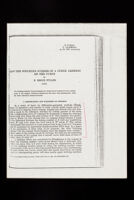
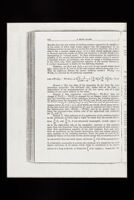
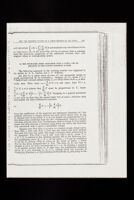
![how the writktng number of a curve depends on the curve 1331 rotai curvature j x ds = ^ T | di and hence for any two of these curves rlie right-hand side of the inequality will be no greater than a constant times the maximum magnitude of the difference between their unit tangents taken at corresponding points. ii. the twist-free strip associated with a curve axd its relation to the curve's writhing number The following approach to the writhing number was suggested to the author by S. A. Andrea and J. P. Fillmore. Let X(s) be a space curve of.class G 2 , not necessarily simple or closed,, parametrized by its arclength s. Suppose (X, U), where U is a f-field of unit normals defined along X, is a strip whose twist cù x is iden tically zero. Then since 01,=— JJ-Y — 0 and since, from Ï7 2 =l, ds il U- U = 0 it follows that — U must be proportional to T ; hence (1 .v ds — = — [u • — t \ t . Changing to a general parameter ds V ds ) I ds J we find that the normal field U(t) of such a twist-free strip must satisfy the linear differential equation (1) — Ü = -(V-A T W ' d< l di ; Since the coefficients of the equation are continuous functions of t the equation will have a unique solution for each initial choice U(a). It can l>e checked that if the initial U is of unit length and perpendicular to T then these same conditions hold for all t. Consequently there is a unique twist-free strip for each U(a). Furthermore, since a change of U{a) merely rotates the strip through a constant angle about the curve, the twist-free •strip associated with a curve is essentially unique. Suppose now that X(t), a < t < b, is a smooth simple closed curve, i Then X(a) = X(b) and T(a) = T(b), but the initial and final normals U(a) and U{b) may not agree. The angle 0 between them determined by the equations U(a)- U(b) = cos 0 and U(a)-V(b) = sin 0, where V — = T X U, is related to the writhing number Wr in the following way. The neighboring curve X z = X + e U for small s > 0 can be completed : hy an arc T c joining zU(b) to zU{a) on the circle of radius s about -¿(a) in the plane perpendicular to T(a). The strip (X, U) can then be thought to have its twist concentrated at t = a ; by forming a sequence U n of smooth normal fields to X such that the neighboring displaced curves X + zU n converge to X. + J E , writing down the equation of White ( [4], Theorem 1, or [2], definition of Wr) for the U n and going to the](https://iiif.wellcomecollection.org/image/b18179654_PP_CRI_H_6_12_2_0006.jp2/full/800%2C/0/default.jpg)