Content advisory
This digitised material is free to access, but contains information or visuals that may:
- include personal details of living individuals
- be upsetting or distressing
- be explicit or graphic
- include objects and images of objects decontextualised in a way that is offensive to the originating culture.
Licence: In copyright
Credit: "Linking numbers and nucleosomes". Source: Wellcome Collection.
9/24
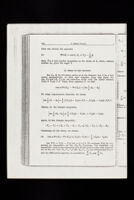
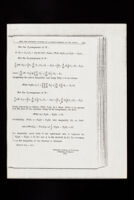
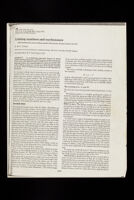
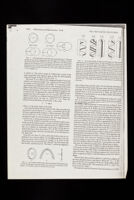
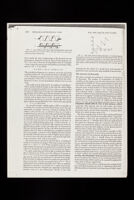
![Vwc. Natl. Acad. Sci. USA Vol. 73, Nò. 8, pp. 2639-2643, August 1976 Mathematics and Biochemistry Linking numbers and nucleosomes (DNA double helix/twist/writhing number/chromosome structure/simian virus 40) f. H. C. Crick Medical Research Council Laboratory of Molecular Biology, Hills Road, Cambridge CB2 2QH, England Contributed by F. H. C. Crick, May 21,1976 ABSTRACT In considering supercoils formed by closed double-stranded molecules of DNA certain mathematical con cepts, such as the linking number and the twist, are needed. The meaning of these for a closed ribbon is explained and also that of the writhing number of a closed curve. Some simple examples are given, some of which may be relevant to the structure of chromatin. It is not easy to think clearly about the way in which double- stranded DNA twists into various coils and supercoils. The subject has been greatly clarified by the mathematician F. Brock Fuller in a paper entitled The writhing number of a space curve (1). This paper is written in a clear, concise manner but its very compactness makes it difficult to grasp for the av erage molecular biologist. This note is an expansion and clari fication of part of his paper. See also an earlier paper by White (2) and a further paper by Fuller (3). The reader should recall two elementary facts about helices and handedness. The first is that a right-handed helix is right- handed from whatever position one looks at it. If it is turned end to end it stays right-handed. The second is that if a right-handed helix is viewed in a mirror, or inverted through a center of symmetry, it becomes left-handed, and vice versa. The basic ideas The essential concept we use is that of a ribbon. This ribbon can be thought of as a pair of lines—its two edges. Mathematically these are considered to be a minute distance apart. In reality the ribbons we will be considering will have finite width but we shall have the physical restriction that our ribbons cannot interpenetrate. We shall mainly be considering closed ribbons, I which join back on themselves. It is assumed that each edge joins only with itself —and not with the other edge as in a Möbius strip. To underline this and to relate our ideas to the physical structure of the double helix of DNA, whose two chains run antiparallel rather than parallel, we put arrows, all pointing the same way, on one edge of the ribbon (in an arbitrary chosen direction) and label the other edge with arrows in the opposite direction. If we have occasion to break lines and join them we can only join lines pointing in the same direction. That is, we assume that we cannot join, by chemical bonds, a DNA back bone of one polarity to one of opposite polarity. 4 The line running along the center of the ribbon, which we shall call its axis, is also important. For a closed ribbon it joins back on itself. It does not have a direction. I Now we have to grasp three distinct but related concepts. These are: (a) the Linking Number, L; (b) the Twist, T; ( c ) the Writhing Number, W. The first important thing to realize is that the first two, L and T, are properties of a ribbon. They have, in general, no meaning for a single curve such as the axis of the ribbon. The Writhing Number, on the other hand, is the property of a closed curve, such as the ribbon axis. Its value depends on the exact shape of the curve in space, but not where 'he curve is in space (is invariant under rigid motions) nor on the scale (invariant under dilatations). The mirror image of any curve has a writhing number of the same magnitude but of opposite sign. Thus, the writhing number of any curve which is its own mirror image (such as a circle) is necessarily zero. A curve which has a center of symmetry also has a zero writhing number. The essence of Fuller's definition of the writhing number is the equation: W = L - T In short, although both L and T are properties of a ribbon, their difference (where they are suitably defined) is a property only of the ribbon's axis and not at all of the way in which the ribbon is twisted about that axis. The meaning of L, T, and W We must now state more precisely what is meant by L, T, and W. The linking number, L, is roughly speaking the number of times the closed line along one edge of the ribbon is linked, in space, with the closed line along the other edge. For example, a ribbon forming a simple (untwisted) circle has linking number zero, since the two distinct circles formed by the edges are not linked in space. The linking number for a closed ribbon is necessarily an integer but as we shall see it can be positive or negative. It is unaltered under all deformations of the ribbon which do not tear it (which deform it smoothly) and is therefore a topological property. We shall not define it more precisely here but later in this paper we give an algorithm for calculating it. In order to give a sign to the linking number we must, in ef fect, put arrows on the two edges of the ribbon. We have al ready chosen to have these arrows run in opposite directions on the two edges because of the structure of DNA. [Mathematically this is not essential. In Fuller (1) the arrows are defined to run in the same direction.] Then a strip which is twisted in a right-handed manner will be given a positive linking number. To make the sign convention quite clear we illustrate two strips, one right-handed and one left-handed, in Fig. la and b. We can deform these figures to give the arrowed lines shown in Fig. lc and d, which also illustrate the convention. Fig. le illustrates a (deformed) ribbon with a linking number of +2. The mirror image of a ribbon, or the ribbon inverted through a center, has L of the same magnitude as the original ribbon but of opposite sign. We must now tackle the twist T. The exact definition, fol lowing Fuller (1), is given in the Appendix but at this stage all the reader needs is an intuitive idea of the twist. Note first that a simple bend (Fig. 2a) does not introduce a twist, nor does the bend shown in Fig. 2b, in which the de formed ribbon lies in one plane. On the other hand the twisted ribbon shown in Fig. 3c clearly has a twist under any definition. The units of twist are chosen so that the stretch of ribbon shown in this figure, which goes round 360° (that is, 2tt radians) is defined to have a twist of 1. Since the twist is right-handed it](https://iiif.wellcomecollection.org/image/b18179654_PP_CRI_H_6_12_2_0009.jp2/full/800%2C/0/default.jpg)
 No text description is available for this image
 No text description is available for this image
 No text description is available for this image