Assimilative memory, or, How to attend and never forget / by A. Loisette.
- Loisette, A. (Alphonse)
- Date:
- 1899
Licence: Public Domain Mark
Credit: Assimilative memory, or, How to attend and never forget / by A. Loisette. Source: Wellcome Collection.
140/184 (page 128)
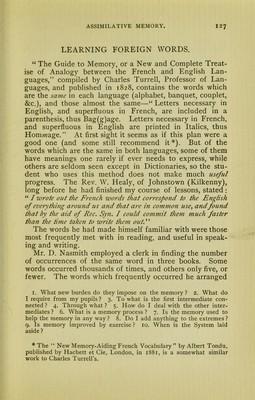
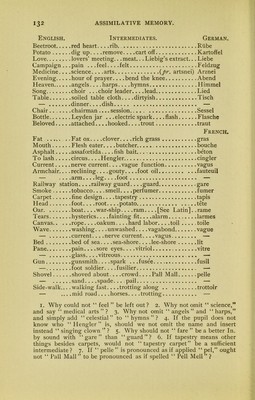
![in order, the commonest first, and compiled exercises to suit them. His “Linguists” (German and French) are published by Mr. D. Nutt, of 270, Strand, London, and by the aid of them, and of my System, a useful knowledge of German (or French) can be rapidly acquired. A pupil who had a very slight acquaintance with French learned an Analytic Series of French words, asking a French friend the meaning and pronunciation of the words unfamiliar to him. By doing this he in about an hour learned the spelling, pronunciation, and meaning of nearly 100 French words. Since then he has been extending the exercise, and in that way he has learned 1,000 French words. In doing so he is strengthening his memory by exercising it in accordance with its own laws, increasing the control his will has over his attention, and extending his French vocabulary. To remember Unfamilar English Words or foreign WORDS, correlate the Definition as the best known to the Unfamiliar or Foreign Word, and memorise the Correla- tion. In the case of Foreign Words, the last Intermediate is necessarily a case of Inclusion by sound. Sometimes there is In. by sight or by sound between a part or the whole of the English word, and a part or the whole of its Foreign equivalent, as .^^ple—apit\ [German]. Of course, the pupil will not need the aid of a correlation in such cases if he notice the analytic relation. The French word AnachorUe might have for its equivalent by sound either Aii7ia^' or Core.,' or ^*'Ate”ov Afina goes /ate,” or Ann a core ate,” or Annas cold hate,” and perhaps to some of my readers it would seem like something else. Cravachemi^t sound like Crack of lash.” Pupils often disagree as to what is good Inclusion by sound ; let each use what suits himself, and not trouble about other people’s ears. In. by sound., or by sense, or by spelling, is sufficient even if it refers to only one syllable. I. Do we ever see words spelt differently but with the same pronun- ciation ? 2. Is the use of the Dictionary required ? 3. What examples have we here of the benefits derived from Rec.-Synthesis ? 4. With what words did he make himself familiar ? 5. Does the same word frequently occur in a book ? 6. What proof can you mention ? 7. What task was accomplished in about one hour by one of my pupils ?](https://iiif.wellcomecollection.org/image/b28134096_0142.jp2/full/800%2C/0/default.jpg)