Assimilative memory, or, How to attend and never forget / by A. Loisette.
- Loisette, A. (Alphonse)
- Date:
- 1899
Licence: Public Domain Mark
Credit: Assimilative memory, or, How to attend and never forget / by A. Loisette. Source: Wellcome Collection.
46/184 (page 34)
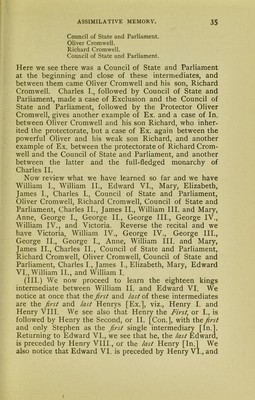
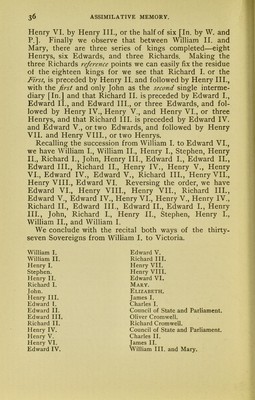
![And these two co-equal Sovereigns were preceded by James the Second, or II. [In., between cardinal number and the ordinal number Second\ This series of Queens concludes with Victoria the fo2irth Queen, who was pre- ceded by William the Fourth, or IV. [In.], and William the Fourth, or IV., was preceded by George the Fou?'th, or IV. [In.] ; and George IV. by George III., and he by George 11., and he by George I.,—a concurrence reversed, and William IV. was preceded, as we have seen, by William III. and Mary—and William III. by William II., and William I. at the very beginning of the series—Con. Now let us recall in the forward and reverse order what we have learned so far. William I., William II., Edward VI., Mary, Elizabeth, James I., James II., William III. and Mary, Anne, George I., George II., George III., George IV. , William IV., and Victoria, and the order reversed is Victoria, William IV., George IV., George III., George II., George I., Anne, William III. and Mary, James II., James 1., Elizabeth, Mary, Edward VI., William II., William I. (II.) Disregarding for the moment the four periods of what is usually called the Commonwealth, we see that between Elizabeth and William III. and Mary, are four monarchs, the two James and the two Charles. We have already learned that Elizabeth was followed by James I. and that William III. and Mary were preceded by James II. Hence we see that the two Charles must come between the two James, and, of course, that Charles I. must precede Charles II., and that the order of these four monarchs 77iust be James I., Charles I., Charles II., and James II.—a plain case of Con. reversed. We saw that there were two of these four monarchs before the Commonwealth; there must then be two after it, making James I. and Charles I. before the Commonwealth and Charles II. and James II. after it. On the day that Charles I. was executed (January 30, 1649), the Parliament (the House of Commons) abolished the kingly office and House of Lords, and appointed a Council of State of 41 members, which with the House of Commons was to be the government. Inter- mediate then between Charles I. and Charles II. there came—](https://iiif.wellcomecollection.org/image/b28134096_0048.jp2/full/800%2C/0/default.jpg)