Villages of the Algonquian, Siouan, and Caddoan tribes west of the Mississippi / by David I. Bushnell, jr.
- David I. Bushnell
- Date:
- 1922
Licence: Public Domain Mark
Credit: Villages of the Algonquian, Siouan, and Caddoan tribes west of the Mississippi / by David I. Bushnell, jr. Source: Wellcome Collection.
47/292 (page 17)
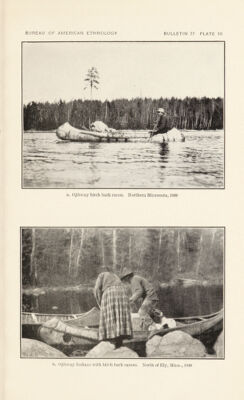
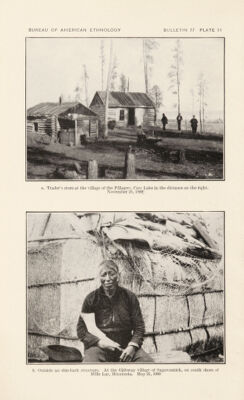
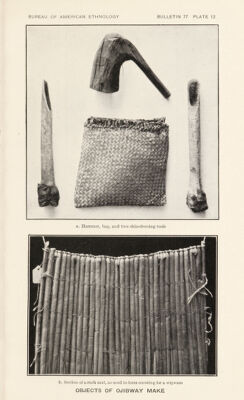
![that it was thought useless to run any risk for the short distance we would be able to make against it. In the evening our Indians con¬ structed a jonglerie, or medicine lodge, the main object of which was to procure a fair wind for next day. For this purpose they first drive ten or twelve poles, nine or ten feet long, into the ground, enclosing a circular area of about three feet in diameter, with a boat sail open at the top. The medicine-man, one of which is generally found in every brigade, gets inside and commences shaking the poles violently, rattling his medicinal rattle, and singing hoarse incanta¬ tions to the Great Spirit for a fair wind. Being unable to sleep on account of the discordant noises, I wrapped a blanket round me, and went out into the woods, where they were holding their midnight orgies, and lay down amongst those on the outside of the medicine lodge, to witness the proceedings. I had no sooner done so than the incantations at once ceased, and the performer exclaimed that a white man was present. How he ascertained this fact I am at a loss to surmise . . . The Major, [M’Kenzie] . . . with many other intelli¬ gent persons, is a firm believer in their medicine.” (Kane, (1), pp. 439-441.) In addition to the several forms of structures erected by the Ojib¬ way, as already described, they reared the elm-bark lodge which re¬ sembled in form the log cabin of the early settlers. Three of these were standing on the south shore of Mille Lac, Minnesota, during the spring of 1900, and the outside of one, showing the manner in which the bark covering was placed, is indicated in plate 11, h. This was similar in shape to the Sauk and Fox habitation reproduced in plate 19, although the Ojibway structure was more skillfully constructed. Habitations of a like nature were found among the Sioux villages on the banks of the Mississippi in the vicinity of Fort Snelling, and others were erected within a generation by the Menomini in northern Wisconsin, but whether this may be considered a primitive form of structure has not been determined. A trader’s store standing near the Ojibway village on the shore of Cass Lake, Minnesota, during the late autumn of 1899 is shown in plate 11, a. Similar cabins were occupied by some of the Indian families, these having taken the place of the native wigwams. Various objects of primitive forms, made and used by the Ojibway within a generation, are shown in plates 12 and 13. CREE. The Cree (the Knisteneaux of Mackenzie) were closely related to the Ojibway; they spoke the same language, and had many customs in common. As Hayden wrote: “ The Cree nation was originally a portion of the Chippewa, as the similarity of language proves; and](https://iiif.wellcomecollection.org/image/b29828685_0047.jp2/full/800%2C/0/default.jpg)