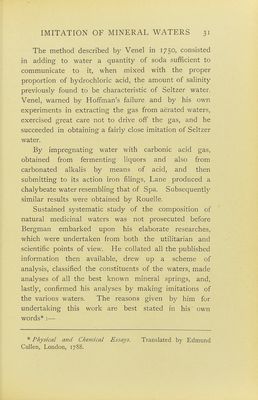
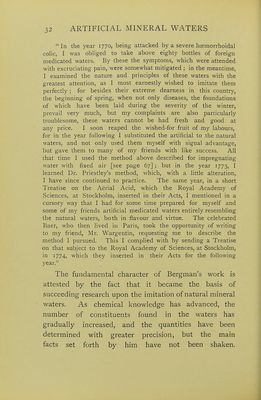
The evolution of artificial mineral waters / by William Kirkby.
- Kirkby, William
- Date:
- 1902
Licence: In copyright
Credit: The evolution of artificial mineral waters / by William Kirkby. Source: Wellcome Collection.
Provider: This material has been provided by Royal College of Physicians, London. The original may be consulted at Royal College of Physicians, London.
43/220 page 27
![Epsom, or Seidlitz, salt and the Rochelle salt, therefore, seem to have been discovered about the same time, and when the advantages of the latter became known, it is not surprising that it should have been preferred as a saline aperient. The popular effervescing powders, patented by T. F. Savory, in 1815, under the name of Seidlitz powders, because they possess the properties (not the ingredients) of the water of the Seidlitz spring, have as their chief constituent Seignette's Rochelle salts. Thus this salt was almost the first, and it remains to-day one of the most generally used, of the substitutes for natural mineral waters. Although some of the early imitations of natural mineral waters would be accepted to-day with approbation, there were others which would hardly commend themselves for general use. Lemery gives prescriptions for two* which illustrate this remark, as will appear from the following translation :— A very beneficial mineral water can be made by dis- solving six drachms of sel vegetal [soluble tartar, that is, the neutral tartrate of potassium] in a pound and a half of water, to be drunk in the morning, fasting, a glassful being taken every quarter of an hour while the patient is taking walking exercise. The following is not quite so unobjectionable, and bears the full impress of the antique :— An aperitive water may be made by dissolving eight or nine grains of gilla vitrioli, or vitriol vomitif [zinc sulphate], in * Cours de Chymie.](https://iiif.wellcomecollection.org/image/b23983267_0045.jp2/full/800%2C/0/default.jpg)