The microscope : its history, construction, and application, being a familiar introduction to the use of the instrument, and the study of microscopial science / By Jabez Hogg ... with upwards of five hundred engravings and coloured illustrations by Tuffen West.
- Jabez Hogg
- Date:
- 1867
Licence: Public Domain Mark
Credit: The microscope : its history, construction, and application, being a familiar introduction to the use of the instrument, and the study of microscopial science / By Jabez Hogg ... with upwards of five hundred engravings and coloured illustrations by Tuffen West. Source: Wellcome Collection.
Provider: This material has been provided by the Harvey Cushing/John Hay Whitney Medical Library at Yale University, through the Medical Heritage Library. The original may be consulted at the Harvey Cushing/John Hay Whitney Medical Library at Yale University.
754/830 (page 714)
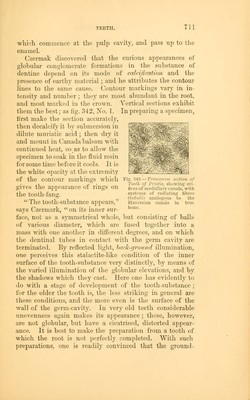
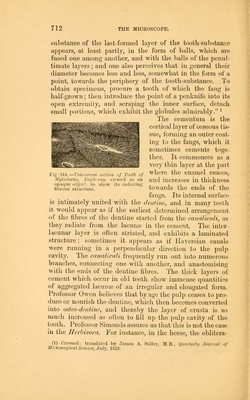
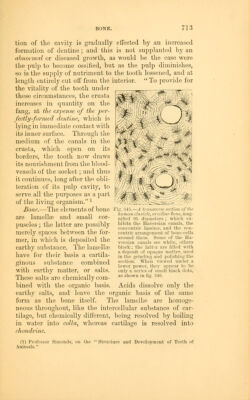
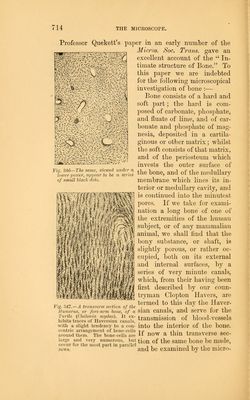
![of small black dots. Professor Quekett's paper in an early number of the Micros. Soc. Trans, gave an excellent account of the In- timate structure of Bone. To this paper we are indebted for the following microscopical investigation of bone :— Bone consists of a hard and soft part; the hard is com- posed of carbonate, phosphate, and fiuate of lime, and of car- bonate and phosphate of mag- nesia, deposited in a cartila- ginous or other matrix; whilst the soft consists of that matrix, and of the periosteum which invests the outer surface of Fig. 346—TTte same, viewed under a .-k i •, n .i ,^Tp(],illqT.v louver poiver, appear to be a serUs '''^ UOne, anci 01 IU.G meciUiJary membrane which lines its in- terior or medullary cavity, and is continued into the minutest pores. If we take for exami- nation a long bone of one of the extremities of the human subject, or of any mammalian animal, we shall find that the bony substance, or shaft, is slightly porous, or rather oc- cupied, both on its external and internal surfaces, by a series of very minute canals, which, from their having been first described by our coun- tryman Clopton Havers, are ^. „ ^ , termed to this day the Haver- F)g. ?.47.—A transverse section of the . , , ^ „ ., Humerus, or fore-arm hone, of a sian canals, and servo lor the hi^^f«%Sof HnvpS , T transmission of blood-vessels nibits traces 01 Haversian canals, with a slight tendency to a con- into the interior of the bone. centric arrangement of bone-cells tj? ^.^ •„ j. . around them The bone-cells are ^^^ ^ thin traUSVerse SBC- large and very numerous, init ti^n of the Same bone be made, occur for the most part m parallel . , ■ t ^ ,t rows. and be examined by the micro-](https://iiif.wellcomecollection.org/image/b21019794_0754.jp2/full/800%2C/0/default.jpg)