The physique of European armies / Walter Montagu Gattie.
- Gattie, Walter Montagu.
- Date:
- [1890]
Licence: Public Domain Mark
Credit: The physique of European armies / Walter Montagu Gattie. Source: Wellcome Collection.
Provider: This material has been provided by The Royal College of Surgeons of England. The original may be consulted at The Royal College of Surgeons of England.
3/22 page 567
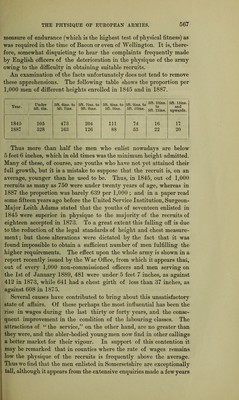
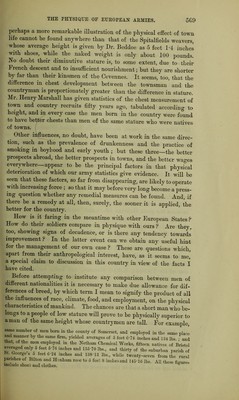
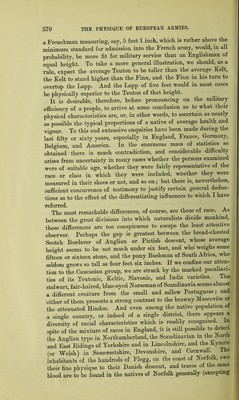
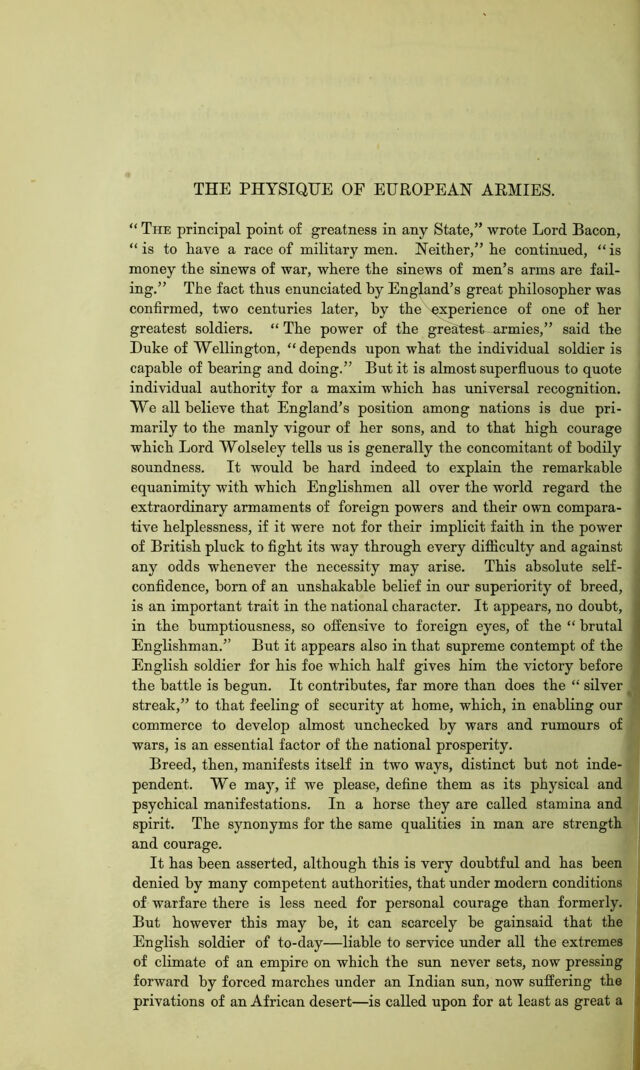
![measure of endurance (whicli is the highest test of physical fitness) as was required in the time of Bacon or even of Wellington. It is, there- fore, somewhat disquieting to hear the complaints frequently made by English officers of the deterioration in the physique of the army owing to the difficulty in obtaining suitable recruits. An examination of the facts unfortunately does not tend to remove these apprehensions. The following table shows the proportion per 1,000 men of different heights enrolled in 1845 and in 1887. Year. Under 5ft. Sins, to 5ft. Tins, to 5ft. Sins, to 5ft. 9ins. to 6ft. loins, to 5ft. llins. 5ft. llins. and upwards. i 6ft. 6in. 6ft. Tins. 6ft. 8ms. 5ft. 9ins. 5ft. loins. 1845 105 473 204 Ill 74 16 17 1887 1 528 163 126 88 53 22 20 Thus more than half the men who enlist nowadays are below 5 feet 6 inches, which in old times was the minimum height admitted. Many of these, of course, are youths who have not yet attained their full growth, but it is a mistake to suppose that the recruit is, on an average, younger than he used to be. Thus, in 1845, out of 1,000 recruits as many as 750 were under twenty years of age, whereas in 1887 the proportion was barely 639 per 1,000 ; and in a paper read some fifteen years ago before the TInited Service Institution, Surgeon- Major Leith Adams stated that the youths of seventeen enlisted in 1845 were superior in physique to the majority of the recruits of eighteen accepted in 1873. To a great extent this falling off is due to the reduction of the legal standards of height and chest measure- ment ; but those alterations Avere dictated by the fact that it was found impossible to obtain a sufficient number of men fulfilling the higher requirements. The effect upon the whole army is shown in a report recently issued by the War Office, from which it appears that, out of every 1,000 non-commissioned officers and men serving on the 1st of January 1889, 481 were under 5 feet 7 inches, as against 412 in 1873, while 641 had a chest girth of less than 37 inches, as against 608 in 1875. Several causes have contributed to bring about this unsatisfactory state of affairs. Of these perhaps the most influential has been the ' rise in wages during the last thirty or forty years, and the conse- i quent improvement in the condition of the labouring classes. The attractions of “ the service,” on the other hand, are no greater than j they were, and the abler-bodied young men now find in other callings I a better market for their vigour. In support of this contention it ] may be remarked that in counties where the rate of wages remains low the physique of the recruits is frequently above the average. Thus we find that the men enlisted in Somersetshire are exceptionally tall, although it appears from the extensive enquiries made a few years](https://iiif.wellcomecollection.org/image/b22474973_0005.jp2/full/800%2C/0/default.jpg)