On the pathology and treatment of valvular disease of the heart and its secondary affections : being the Gulstonian lectures, delivered at the Royal College of Physicians in February 1851 / by Edward Latham Ormerod.
- Edward Ormerod
- Date:
- 1851
Licence: Public Domain Mark
Credit: On the pathology and treatment of valvular disease of the heart and its secondary affections : being the Gulstonian lectures, delivered at the Royal College of Physicians in February 1851 / by Edward Latham Ormerod. Source: Wellcome Collection.
Provider: This material has been provided by The Royal College of Surgeons of England. The original may be consulted at The Royal College of Surgeons of England.
48/62 page 48
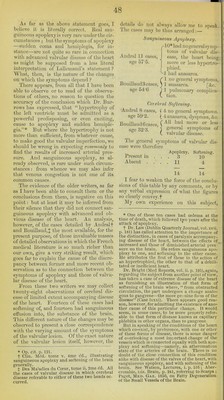
![As far as the above Btatoment goes, I boliovo it is litorally conr(!t. Real sau- guinoous apoplexy is very rare under the eir- cuuistaiicos ; but the symptoms of a))oplexy —sudden coma and lieniiplegia, for in- stance—ai'o not quite so rare in eonucetion with advanced valvidar disease of tlio lieoi-t as miglit be supposed from a less Uteral interpretation of Lallemantl's statement ? Wliat, then, is tlio nature of tiie changes on which tlie symploms dejiend H There appcar-s, from all that 1 have been able to observe or to read of tlie observa- tions of others, no reason to question the accuracy of the conclusion which Dr. Bur- rows has expressed, that hyiiertro]ihy of the left ventricle must be admitted as a powei'fal predisposing, or even exciting, cause to apoplexy and sudden hemiple- gia.* But where the hypertrophy is not more than sufficient, from whatever cause, to make good the valvular imperfection, we should be wrong in expecting commonly to find the results of mcreased arterial pres- sure. And sanguineous apoplexy, as al- ready observed, is rare \mder such cu'cum- stances: from whence we may also infer that venous congestion is not one of its common causes,. The evidence of the older writers, as far as I have been able to consult them or the conclusions from them, is negative on this point: but at least it may be inferred fi-om their silence that they did not connect san- guineous apoplexy with advanced and ob- vious disease of the heart. An analysis, however, of the cases detailed by Andralf and Boiullaud,J the most available, for the present purpose, of those invaluable masses of detailed obsei-vations in which the French medical hteratm-e is so much richer than our own, give a very striking result, wliich goes far to explain the caiise of the discre- pancy between former and more recent ob- servation as to the connection between the symptoms of apoplexy and those of valvu- lar disease of the heart. From these two writers we may collect twenty-eight observations of cerebral dis- ease of hmited extent accompanying disease of the heart. Fom-teen of these cases had softening of, and fourteen had sanguineous effusion into, tlie substance of the brain. This different natui-e of the changes may be observed to present a close correspondence with the varying amomit of the symptoms of the valvular lesion. Of the exact nature of the valvular lesion itself, however, the * Op. cit. p. 121. t Clin. M(^d. tome v. 4me M., illustrating san^neous apoplexy and softening of the brain generally. .. % Des Maladies du Coenr, tome n. 2me od. All the cases of valvular disease in which cerebral disease referable to either of these two heads oc- curred. details do not always allow me to speak. The cases may bo thus ari'anged :— Sant/uineom Ajniplexy. /-10*liad nogeneralsyrn])- tonis of viilvukr dis- Andral 11 cases, J ease, the heart being age 57'5. j more or less hypertro- phied. ^1 liad anasarca. r 1 no general symptoms, Bouillaud3cases, ) 1 anasarca. [&c. age 54-C ) 1 pulmonary compUca- (. tion. Cerebral Softening. Andral 8 cases, ( 4 no general symptoms age 59-2. B ouillaud 6 cases age 32-3 ( 4 anasarca, dyspnaa, &x;. All had more or less general symptoms of valvular disease. 1 The general symptoms of valvular dis- ease were therefore Apoplexy. Softening. Present in ... 3 lo Absent .... 11 4 14 14 I fear to weaken the force of the conclu- sions of tliis table by any comments, or by any vel-bal expression of what the figure's so clearly couvey.f My own experience on this subject, * One of these ten cases had oedema at the time of death, which followed two years after the attack of apoplexy. t Dr. Law (Dublin Quarterly Journal, vol. xvii. p. 181) has called attention to the importance of the distinction, in cases of paralysis accompany- ing disease of the heact, between the effects of increased and those of diminished arterial pres sure on the brain. He refers sanguineous apo- plexy to one^ and softening to the other cause. He attributes the first of these to the action of an hypertrophied, the other to that of a debili- tated or inelficient heart. Dr. Bright (Med Reports, vol. ii. p. 195), again, regarding the subject from another point of view, has taken a case of extreme disease of the heart as furnishing an illustration of that form of softening of the brain where, from obstructed circulation, the pai-t undergoes a chiinge analo- gous to gangrene—the more genuine form of the disease (Case I.vxxi). There appears good rea- son, however, for admitting the existence of ano- ther cause of this particular change. It would seem, in some cases, to be more properly refer- able to that form of disease known as capillary phlebitis in other organs, than to gangrene But in speaking of the conditions of the heart which co-pxist, by preference, with one or other of these forms of disease, there is some danger of overlooking a most iui| ortant change of the vessels which is connected equally with both apo- plexy and softening—namely, an atheromatous state of the arteries of the brain. There is no doubt of the close connection of this condition alike with disease of the valves of the heart, witli sanguineous apoplexy, and with softening of the brain. See M'atson, Lectures, i. p. 516 ; Aber- crombie, i>is. Brain, p. 241, referrn\g to Scar^)a ; I'aset, Med. Gaz. 1850, on Fatty Degeneration of the Small Vessels of the Brain.](https://iiif.wellcomecollection.org/image/b22305609_0050.jp2/full/800%2C/0/default.jpg)


 No text description is available for this image
 No text description is available for this image
 No text description is available for this image