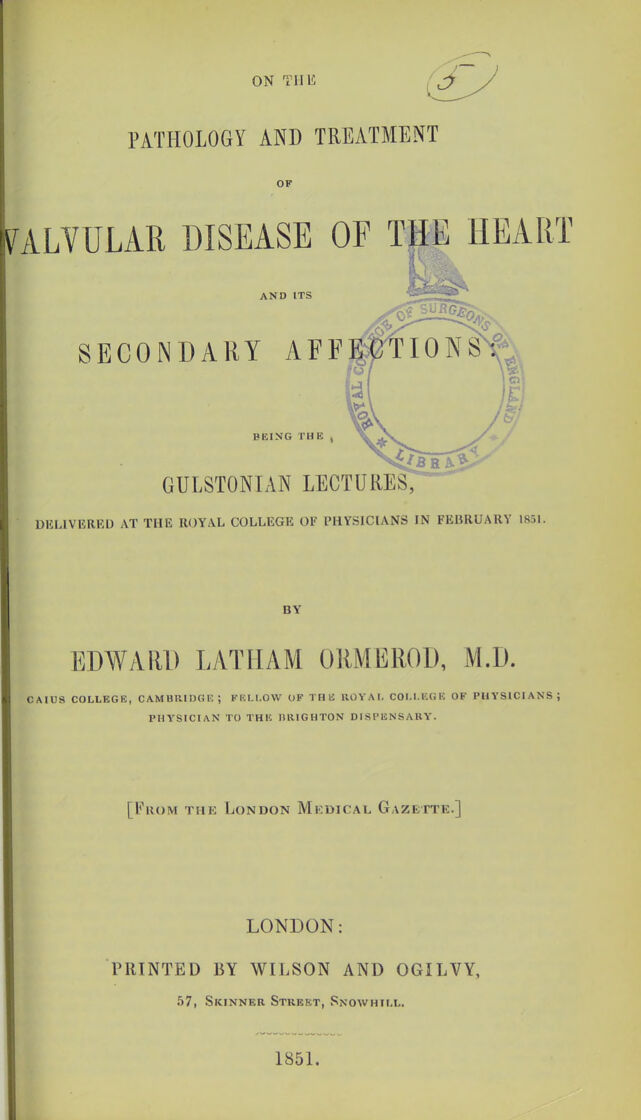
On the pathology and treatment of valvular disease of the heart and its secondary affections : being the Gulstonian lectures, delivered at the Royal College of Physicians in February 1851 / by Edward Latham Ormerod.
- Edward Ormerod
- Date:
- 1851
Licence: Public Domain Mark
Credit: On the pathology and treatment of valvular disease of the heart and its secondary affections : being the Gulstonian lectures, delivered at the Royal College of Physicians in February 1851 / by Edward Latham Ormerod. Source: Wellcome Collection.
Provider: This material has been provided by The Royal College of Surgeons of England. The original may be consulted at The Royal College of Surgeons of England.
5/62 page 5
![*■ many of the difficulties which beset the earhest ausciiltators, by his coiTCct mter- ' prctation of the second sound. Dr. Hope has applied all this knowledge to practice in his doctrine of regurgitation, hereby explaining symptoms wliich occur in a 'i large proportion of all cases of heart dis- ease, and which must, before his discovery, have been misinterpi-eted. Meanwhile, by a close scrutiny of the chai'acter of particu- lar mm-murs, and the circumstances imder ' which they occur, the categoiy of valvular murmm's has been weeded of some that did not properly belong to it. Dr. Ogier '• Ward has brought an entirely new element \ into the field by his discoveiy of what we ' now call the venous miu-mur,* and thus • suppHed us with a means whereby to in- t vestigate the nature and causes of coinci- e dent arterial mm-murs : in the same way, as ah'eady noticed, pericai'dial liave been distinguisded from endocardial murmurs. To our knowledge of the physical condi- tions for the production of murmurs gene- rally, no entirely new fact has been added, as might, indeed, have been expected ; for the tlieories which stUl divide opinion were all foreshadowed by Laeunec,t thougli he does not appear always to have chosen the best of them. Much as auscultation is indebted for the rapidity of its progress to the talent of these oi'iginal observers, it is no less in- debted for tlie steadmess of its advance to the zeal and industry with which less gifted individuals have followed in their track, to confirm or correct their conclu- sions by a continual recurrence to tlie ob- servation of nature. Scarce a stone is laid in the stru(iture but it is marked by the name of liim who placed it tliere, and by the names of tliose wlio have tried its sta- biUty and soimdness in all possible ways. For any statement to be generally received witli regard to the diagnosis of disease of tlie lieart, indeed, it needs to be quite in- dubitable. Still, with all this, the subject is far from complete, even to the extent that the best auscultators and most accomplished physi- cians may pronounce disease to be present when it is not—even to the extcTit that the most confinned valvular disease may some- times esca]ie detection.;!: The interpretation he dull snniirt of hypertropliv, niirt the sharp lick of (tiiiitation, as illiistratir.ff the muscular >n(l valvular eli-meiits of the first sound, respec- .ively, in their extreme desrrees. 1 cannot re- concile with patholoirical observation anv theory wliich woiiUl exclude either of these from the formation of the normal first sound of the heart. * .Mhdical Gazkttk, vol. XX. p. 9. + Hope on th!' I I(!art, pp. 80-9G, et seq. i The Duhlin School of Patholof!;y, to which we owe so much in the knowledg-e of ciscases of of the common valvular murmurs is not yet perfect; and there are some less com- mon signs, such as j^m-ring tremor and metallic cliquetis, of wliich something has yet to be learned. There is reason to think that we know little more than half of the causes of valvular disease, and the progress of that disease on the valves needs to be more fully traced. And the whole sad subject of death by disease of the heart is so continually receiving light fi'om new observations, that its deficiencies, as we have it laid down now, must ob- viously be vei'y many. The subject of diseases of the heart is too large to be included in tlie compass of three lectures: nor, did even time allow me fully to enter upon it, could I ask your attention to my version of what Hope, Latham, Watson, and Williams, have already put forward with more ability and more authority. For the present occasion, the consideration of one part—iwmely, valvular disease — will suffice; and liere, too, rather limiting om'selves to flic exami- nation of a few points which still remaui open to discussion, tlian glancing cursorily over the whole subject. I fear ih:\t this mode of proceeding may give an uncon- nected character to all that I liave to say, and that less important points may obtain undue prominence, while some of the most essential and most practical points arc passed over almost witliout notice : but the circumstances of the case, and tlie nature of the luaterials from whicli these lectures have been composed, render this mode of treating the subject in some sort nec^essary. And I would ofier this series of esscys rather as a commentary on or as suppie- mentary to the more comiilete treatises with which I may assume you to be faini- har, than as constituting in (lieinselvcs a the heart as in other subjects, published in 1K.38 (Dublin Journal, vol. xiv. p. 17S), in t!ie names of Dr. Graves and Dr. .Si nkes, a form-. I expression of the recognised dithcnlties of the phvsical dian;nosis of valvulur disease : — 1. Thatthi' physiciil sisns of valvular d.sease are not yet fully cstahlisl ed 2. That, taken alone, they are in no case suffi- cient for dia^nnsis. 3 That, even in organic diseases, the valurc and situution of murmurs may vary in the course of a fe>v days. 4. That ail varieties of valvular murmurs may occur without organic disease. 5. That orij-anic disease of the valves nuiv exi.- t to a very great degree without any niDrnjur whatsoever. It is a small matter to express my own present assent to these propositions ; but, as it is alwavs harder to profess incompetency than practical superiority, we owe much to Dr. Graves and Dr. Stokes for lending the protection of their names to those who would dare to express a doubt and a difficulty where all may be made to seem ho plausible and so easy.](https://iiif.wellcomecollection.org/image/b22305609_0007.jp2/full/800%2C/0/default.jpg)