On the pathology and treatment of valvular disease of the heart and its secondary affections : being the Gulstonian lectures, delivered at the Royal College of Physicians in February 1851 / by Edward Latham Ormerod.
- Edward Ormerod
- Date:
- 1851
Licence: Public Domain Mark
Credit: On the pathology and treatment of valvular disease of the heart and its secondary affections : being the Gulstonian lectures, delivered at the Royal College of Physicians in February 1851 / by Edward Latham Ormerod. Source: Wellcome Collection.
Provider: This material has been provided by The Royal College of Surgeons of England. The original may be consulted at The Royal College of Surgeons of England.
6/62 page 6
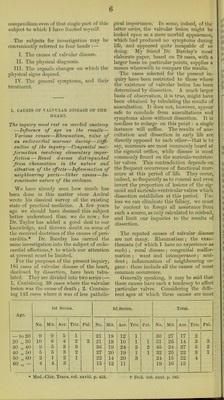
![conipeiidium evon of tlint. ])ari ol' tliis subject to vvliich 1 liuvo limited uiy^ieU'. Tlio subjects for investijrntion may be convoiiieutly referred to four hoiids :— I. The causes of valvular disease. II. The pliysical diagnosis. III. The organic changes on which the physical signs depend. IV. The general symptoms, and then* treatment. I. CAUSES OF TALVTTLAE DISEASE OP THE HEART. The iiiquirxj must rest on morbid anatomy —Influence of age on the results— Various causes—Rheumatism, value of an endocardial murmur during—diffi- culties of the inquiry—Congenital mal- Jormation involving elementary imper- fection— Renal disease distinguished from rheumatism in the nature and situation of the effects—Inflammation of neighbouring parts—Other causes—In- conclusive nature of the evidence. We have ah-eady seen how much has been done in tliis matter since Andi-al wrote his classical siu-vey of the existing state of practical medicme. A few years ago we should have deemed tliis subject better understood than we do now; for Dr. Taylor has added a good deal to our knowledge, and thrown doubt on some of the received doctrmes of the causes of peri- carditis.* Dr. Barclay has carried the same investigation into the subject of endo- cardial aifectionsjt to which our attention at present must be limited. For the purposes of the present inquiry, 181 cases of valvulai- disease of the heart, disclosed by dissection, have been tabu- lated. They are divided into two series :— 1. Containing 39 cases where the valvular lesion was the cause of death ; 2. Contain- ing 142 cases where it was of less patholo- gical imporlanee. In some, indeed, of the latter scries, the valvular lesion might be looked upon as a mere morbid appearance, which had jiroduced no symptoms during life, and appeared quite incapable of so doing. My friend Dr. Barclay's most elaborate paper, based on 79 cases, with a larger basis on particular points, supplies a means wherewith to compare the results. The cases selected for the present in- quiry have been restricted to those where the existence of valvular lesion has been determined by dissection. A much larger basis of observation, it is true, might have been obtained by tabulating the results of auscultation. It does not, however, appear safe to conclude from auscultations and symptoms alone without dissection. It is needless to enlarge on this point: a single instance will suffice. The results of aus- cultation and dissection in early life are directly opposed to each other—that is to say, murmurs are most commonly heard at the sigmoid orifice, while disease is most commonly found on the auriculo-ventricu- lar valves. This contradiction depends on the frequent occun-ence of functional mur- murs at this period of life. They occur, indeed, so frequently as to conceal and even invert the proportion of lesions of the sig- moid and auriculo-ventriculav valves which dissection estabhshes at this period. Un- less we can ehminate this fallacy, we must be content to forego aU assistance from such a source, as only calculated to mislead, and limit our inqmries to the results of dissection. The reputed causes of valvular disease are not many. Rheumatism; the exan- themata (of which I have no experience as such) ; renal disease; congenital malfor- mation ; want and intemperance; acci- dent; inflammation of neighbouring or- gans : these include aU the causes of most common occurrence. Generally speaking, it may be said that these causes have each a tendency to affect particular valves. Considei-mg tlie diffe- rent ages at which these causes are most 1st Series. 2d Series. Total. Age. No. Mit. A or. Trie. Pul. No. Mit. Aor. Trie. Pul. No. Mit. Aor. Trie. Pul. — to 20 9 9 5 1 21 18 12 1 30 27 17 2 20 „ 30 10 8 4 2 2 21 18 10 1 1 31 26 14 3 3 30 „ 40 9 5 3 3 36 19 24 2 2 45 24 27 5 2 40 „ 50 5 5 3 2 27 20 19 1 1 32 25 22 3 1 50 „ 60 2 1 2 1 22 14 20 3 24 15 22 4 60 „ - 4 4 3 15 12 11 19 16 15 * Med.-Chir. Trans, vol. xxviii. p. 453. t Ibid. vol. .xxxi. p. 185.](https://iiif.wellcomecollection.org/image/b22305609_0008.jp2/full/800%2C/0/default.jpg)