Licence: Attribution-NonCommercial-NoDerivatives 4.0 International (CC BY-NC-ND 4.0)
Credit: Race and racism / Ruth Benedict ; foreword by John Rex. Source: Wellcome Collection.
65/212 page 51
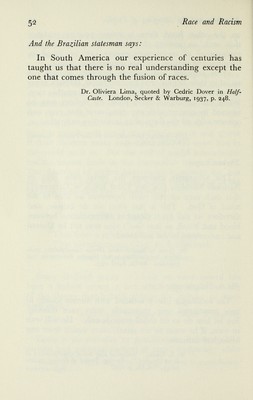
![on the other hand there is strong positive evidence that such an instinct does not exist. An adequate explanation of racial antagonisms can be found in impulses and motives that are independent of race. These impulses and motives, however, though not racial in their origins, may become racial, through being connected in the mind with the thought of another race. When this association takes place the feelings may be aroused by contact with any member of that race, and operate with all the force of an instinctive antipathy. J. H. Oldham, Christianity and the Race Problem. London, S.G.M., 1924, p. 43. The racist says: This accurately expresses the racial view held by National Socialists [i.e. the Third Reich in Germany]: that each race on this earth represents an idea in the mind of God. This is just what we do believe, and therefore we call for a clear-cut differentiation between blood and blood, so that God’s idea may not be blurred and caricatured in the half-breed. W. Gross in Racio-Political Foreign Correspondence , pub lished by the Bureau for Human Betterment and Eugenics. Berlin, April 1935. But the biologist says: The sociologist who is satisfied with human society as now constituted may reasonably decry race crossing. But let him do so on social grounds only. He will wait in vain, if he waits to see mixed races vanish from any biological unfitness. W. E. Castle, “ Biological and Social Consequences of Race-Crossing.” American Journal of Physical Anthro pology , Vol. IX, p. 156.](https://iiif.wellcomecollection.org/image/b18026151_0064.JP2/full/800%2C/0/default.jpg)

 No text description is available for this image
 No text description is available for this image
 No text description is available for this image