[Report 1925] / Medical Officer of Health, Cambridge Borough.
- Cambridge (England). Borough Council.
- Date:
- 1925
Licence: Attribution 4.0 International (CC BY 4.0)
Credit: [Report 1925] / Medical Officer of Health, Cambridge Borough. Source: Wellcome Collection.
8/74 page 6
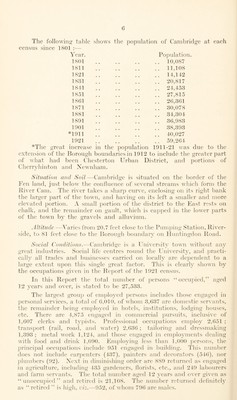
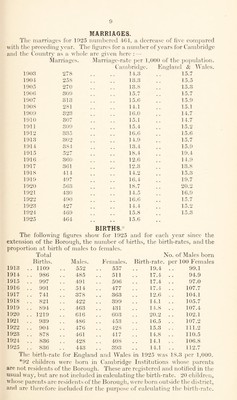
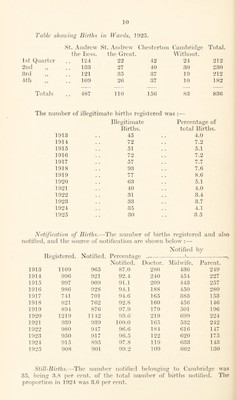
![The followino' table shows the population of Cambridge at eaeh census sinee 1801 :— Year. Population. 1801 1811 1821 1831 1841 1851 1861 1871 1881 1891 1901 *1911 10,087 11,108 14,142 20,817 24,453 27,815 26,361 30,078 34,304 36,983 38,393 40,027 1921 *The great inerease in tlie population 19 59,264 11-21 was due to the extension of the Borough boundaries in 1912 to include the greater part of what had been Chesterton Urban District, and portions of Ciierrvhinton and Xewnliam. Situation and Soil—Cambrido-e is situated on the border of the o Fen land, just below the confluence of several streams which form the River Cam. The river takes a sharp curve, enclosing on its right ])ank the larger ]:)art of the town, and having on its left a smaller and more elevated portion. A small portion of the district to the East rests on chalk, and the remainder on gault, which is capped in the lower parts of the town by the gravels and alluvium. Altitude —Varies from 20.7 feet close to the Pumj)ing Station, River- side, to 81 feet close to the Borough boundary on Huntingdon Road. Social Conditions.—Cambridge is a Uni^'ersity town without any great industries. Social life centres round the University, and ])racti- callv all trades and businesses carried on locally are deiDendent to a c/ 1 large extent upon this single great factor. This is clearly shown by the occupations given in the Report of the 1921 census. In this Report the total number of persons ‘‘occu]:)ied,” aged 12 years and over, is stated to be 27,533. The largest grou}) of em])loyed persons includes those engaged in ])ersonal services, a total of 6,010, of whom 3,637 are domestic servants, the remainder being em})loyed in hotels, institutions, lodging houses, etc. There are 4,875 engaged in commercial pursuits, inclusive of 1,607 clerks and ty})ists. Professional occupations employ 2,651 ; transport (rail, road, and water) 2,636 ; tailoring and dressmaking 1,393; metal work 1,124, and those engaged in cmploymeiits dealing with food and drink 1,090. Employing less than 1,000 persons, the principal occupations include 951 engaged in ])uilding. This number does not include car])enters (437), ]:»ainters and decorators (546), nor plumbers (92). Next in diminishing order are 889 returned as engaged in agriculture, including 435 gardeners, florists, etc., and 249 labourers and farm servants. The total number aged 12 years and over given as “unoccupied” and retired is 21,108. The number returned delinitely as “ retired ” is high, viz.—952, of whom 796 are males.](https://iiif.wellcomecollection.org/image/b29355679_0008.jp2/full/800%2C/0/default.jpg)