A manual of the dissection of the human body / by Luther Holden ; with notes and additions by Erskine Mason.
- Luther Holden
- Date:
- 1868
Licence: Public Domain Mark
Credit: A manual of the dissection of the human body / by Luther Holden ; with notes and additions by Erskine Mason. Source: Wellcome Collection.
Provider: This material has been provided by the Francis A. Countway Library of Medicine, through the Medical Heritage Library. The original may be consulted at the Francis A. Countway Library of Medicine, Harvard Medical School.
26/608 (page 12)
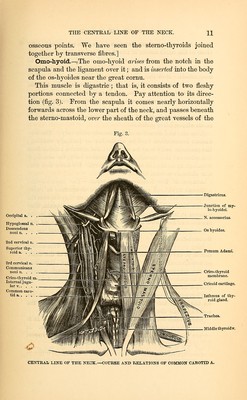
![neck; tlien, changing its direction, it ascends nearly vertically close to the outer border of the sterno-hyoid. Observe, there- fore, that the muscle does not proceed straight from origin to insertion, but that it forms an obtuse angle beneath the ster- no-mastoid. Now the intermediate tendon is situated at the angle, and it is maintained in its angular position by a broad layer of the cervical fascia, which comes up to it from the clavicle. What is the object of this peculiar direction of the omo-hyoid ? I think it is to keep tense that part of the cer- vical fascia which covers the apex of the lung, and thus to resist atmospheric pressure. [The size and direction of this muscle often vary. The ten- dinous intersection may be altogether or partially wanting ; the posterior belly may be wanting; the muscles arising from the centre of the clavicle, or the anterior belly, be absent, it terminating in the fascia over the artery. We have met with this anomaly several times.] Action of the Depressor Muscles.—The sterno-hyoid, sterno-thyroid, and omo-hyoid muscles, co-operate in fixing the larynx and os-hyoides, e. g. in sucking, or they depress the larynx after it has been raised in deglutition. Again, they depress it in the utterance of grave notes. That the larynx is raised or depressed according to the height of the note may be ascertained by placing the finger upon it while we go through the gamut. Now these depressor muscles are all supplied with nerves (fig. 3, p. 11) by the descendens noni (a branch of the ninth, or hypoglossal), and by the communicantes noni (branches of the cervical plexus). The descendens noni sends a sepa- rate branch to each belly of the omo-hyoid. They are sup- plied with blood by the superior thyroid artery. Thyro-hyoid.—The thyro-hyoid arises from the oblique line on the ala of the thyroid cartilage, and is inserted into the body and half the great cornu of the os-hyoides. This muscle is a continuation of the sterno-thyroid. It is supplied by a special branch from the hypoglossal nerve. It covers the thyro-hyoid membrane, and the superior laryngeal nerve and artery as they enter the larynx. We are now about to examine the course and relations of the common carotid artery. But before we do so, you must](https://iiif.wellcomecollection.org/image/b21059342_0026.jp2/full/800%2C/0/default.jpg)