Volume 1
Icones plantarum Indiae Orientalis, or, Figures of Indian plants / by Robert Wight.
- Date:
- 1840-1853
Licence: Public Domain Mark
Credit: Icones plantarum Indiae Orientalis, or, Figures of Indian plants / by Robert Wight. Source: Wellcome Collection.
Provider: This material has been provided by the Royal College of Physicians of Edinburgh. The original may be consulted at the Royal College of Physicians of Edinburgh.
62/702 page 58
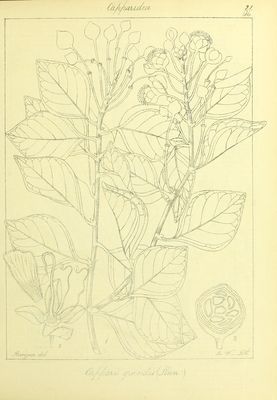
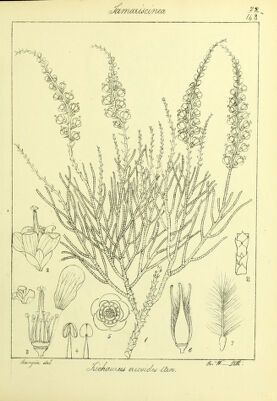
![EXPLANATION OF PLATES. ■ Camparis grandis—natural size—2. A dissected flower, show- 94 iug the sepals, torus, stamens, gynophore, and ovary, with single detached petal-3. A fruit cut transversely—all magnified. 22 . Trichaurus erieoides—natural size—2. A flower, showing the 143 relative size of the different parts—3. The same, the sepals and petals removed showing the insertion of the stamens, the ovary, style and stigmas. The detached figure the stigmas more magnified and a petal—4. Stamens—5. A diagram, snowing the arrangement of the parts of the flo wer— G. A mature capsule burst—7. A seed with its beak—8. A portion of a branch showing the scale-like leaves—all magnified. 23 . Melhania abutiloides—natural size— Branches villous, 250 x 51 ieaves pubescent above, tomentose beneath—2. A dis- sected flower, showing the 3-leaved involucel, (one leaf detached) 5 sepaled calyx enclosing the ovary, and the corolla and stamens detached —3. De tacbed stamens showing their union at the base—4. The capsule surrounded by the persistent involucel—5. The ovary cut transversely 6. One of the carpels, showing by the central position of the partition the loculicidal dehiscence—7. A portion of the under surface of a leaf magnified, to show the pubescence on the leaves which could scarcely have been represented with sufficient delicacy if not magnified. 24. Nephelium rubrum— copied from Roxburgh's drawings deposited nthe Calcutta Botanic garden.—This figure represents a portion of the drawing full size. 25. The same—A greatly reduced figure of the whole—2. A flower opened airi magnified, showing the sepals, petals, linear incurved anthers, obcordate ovary, and 2-cleft stigma—3. Ovary cut vertically, showing its two cells, and solitary erect ovul es—4. Berries—5 . Cu transversely—6. Seed lobes separated, showing the small embryo at the base—7. Embryo detached. See iioxb. Fl. Ind. 2 pg, 272. Yateria Roxburghiana—2. Sepals and ovary, with a single detached petal—3. Sepals and petals removed, showing the stamens and stigma—4-5. Detached stamens, back and front views—6. Ovary cut transversely 3-celled—7. A full grown fruit cut transversely, showing from the solitary seed that all the ovules except one had aborted—8. The same cut vertically, the circular spots are caused by irregularities in the fjrm of the seed lobes, which, when thus cut are divided in several places—9. A seed, natural size—10. The same magnified, showing the manner of its suspension from the top of the cell—all more nrhss magnified. I am indebted to the unaided ingenuity of the artist for these analysis who was not at the time of making them under my superintendence, and I have not since had the m eans of verifying them myself. 27 • Vatica Tumbugaia—natural size—2. Dissected flower, corolla detached to show the sepals, stamens, and stigma—3-4. Sta- mens back and front views, anthers tipped with a tuft of hairs—5. Ovary cut transversely 3-celled, with two ovules in each—6. The same cut vertically, showing the pendulous ovules, conical style, and three stigmas—7. A mature fruit, with its enlarged wing-like sepals— 8. The same, the sepals removed—9. A seed, the testa removed to show the superior radicle-— all more or less magnified. 28 Vitis laccolaria— natural size—2. A flower opened, showing 4'4 the petals, stamens, ovary, and sessile rough stigma—3. The same petals re moved—4. Stamens—5. Ovary cut vertically, ovules soli- tary in each cell, erect —6. The same cut transversely—7. A seed--ai£ wore or less magnified. 29 ■ Crotalaria speciosa—n atitral size—2. A flower detached to ^ show the relative size and position of the involucel, calyx and cnrolla--3 . The same forcibly opened and the petals removed to bring into view, the stamens, style and stigma, showing all the filaments united (momulclph ous,) and the anthers alternately linear and globsse —4. The p etals detached—5. Back and front views of one of the linear anthers.-6. The ovary cut longitudinally, showing the ovules—7. A pod about half grown—8. The same opened—9. A seed—10. Thesame cut transversely, not yet mature—11. A portion of a leaf magnified --all more or less magnified. 30 Crotalaria bifaria—natural size—2. A dissected flower, the 5^3 corolla removed and the calyx opened, showing the mona- delphous stamens, ovary and stigma, the anthers oblong and globose— 3. The petals—4. Ovary cut open to show the ovules—5. Leaves mag- nified to show the pubescence which is very fine---all more or less mag- nified. 31 ■ Crotalaria eroIruloideS--Ba<ura!I size, but a large form and 384 ' perhaps appears more hairy than in nature through the ten- dency of such lines, to become thick in course of printing—2. Petals --3. Calyx forcibly opened to show the stamens, ovary and style—4. Ovary cut lengthwise—5. A pod—6. The same opened—7. A seed.—all more or less magnified. 32 tiG7 Sesbania CEgyptiaca—natural size—- A dissected flower, the petals removed, the calyx laid open to show the diadelphous filaments, 9 and 1, and the anthers all equal—3. A portion of a pod opened, showing the seeds separated by spurious partitions—4-5. Sec- tiuns of a seed—all more or less magnified. 33 7^7 Abrus fruticulosus—natoroZ size—2. A dissected flower wings and keel adhering, stamens tnonadelplrous, much longer than the ovary and style—3. A portion of the pod opened—4. A seed --5. The same, the testa and one seed lobe removed to bring into view the embryo and radicle at the small end—all more or less magnified. 34 —-— Phaseolus rostratus—natural size—2. A flower, the vexil- 'oU ]um removed, and the wings thrown back to show the spirally twisted keel—3. The (petals removed, showing the spirally involute diadelphous stamens and style--!. A portion of the ovary opened, showing the ovules and interposed cellular partitions--o/< more or less magnified. 35 ■ Mucuna monosperma—natural size—2. A dissected flower, the petals removed and the calyx partially opened, showing the diadelphous stamens, (9 andl) anthers oblong and globose, the latter rough—3. The ovary--4. Same cut lengthwise to show the solitary ovule—all more or less magnified--5. A legume—6. The same opened, showing the seed with its long linoar hilum— natural size. 38 Ctesalpinia paniculata--natural size—2. A flower opened to show the different parts—3. The ovary, the calyx and petals, except the vexellum, removed, to show the attachment of that petal--4. A legume opened to show the solitary seed--5. A seed cut transversely. —all more or less magnifiied. 37 Cffisalpinia sepiaria—natural size—2. A dissected flower but 87 i badly represented, in as much as it seems to place three caly- cene lobes in place of two, next the axis—3. A legume, natural me—4. A seed—5. The same, a portion of the testa removed to show the cotyledons and straight radicle in situ—6. The cotyledons iemoved—7. Leaves magnified lo show the pubescence.— all more or less magnijied. 38 ■ Rosa Loschenaultiana—fta<«raZ size—2. A dissected flower, the petals removed, and the segments of the calyx thrown back to show the contraction of the hollow receptacle round the style—3. Au anther—4. The tube of the receptacle cut vertically to show the ovaria concealed within—5. A fruit—6. The same cut vertically—all more or less magnified—I. A cluster of fruit—natural size. 39 1100 Passifiora Leschenaultii—natural size—2. A dissected flower, the calyx removed, and the corolla with one row of the coronal filaments detached, leaving the interior row surrounding the ovary, stamens and styles—3. Two of the coronal filaments more magnified—4. A flower cut vertically, showing the stalk of the ovary surrounded by the united filaments of the stamens, and surmounted by the styles and stigmas—5. The ovary cut transversely—6. Tht same tut longitudinally. 40 — Guetarda speciosa—natural size—2. A dissected flower, showing the tubular truncated calyx : the corolla laid open, the stamens adhering to its inner surface the whole length of the tube, equalling the number of its segments, and alternate with them—3. Ovary cut vertically—4. The same cut transversely showing it, in this instance, 5-celled—5. A full grown fruit cut across—6. The same cut vertically, bringing into view through their whole length two of the curved cells with their enclosed seed--7. A seed removed—all more or less magnijied.](https://iiif.wellcomecollection.org/image/b21912762_0001_0062.jp2/full/800%2C/0/default.jpg)