Volume 1
Descriptive and illustrated catalogue of the physiological series of comparative anatomy contained in the museum of the Royal College of Surgeons in London.
- Royal College of Surgeons of England. Museum
- Date:
- 1833-1840
Licence: Public Domain Mark
Credit: Descriptive and illustrated catalogue of the physiological series of comparative anatomy contained in the museum of the Royal College of Surgeons in London. Source: Wellcome Collection.
Provider: This material has been provided by The University of Glasgow Library. The original may be consulted at The University of Glasgow Library.
285/321 page 259
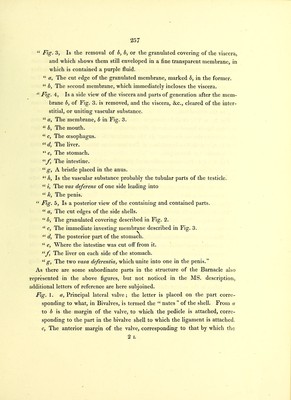
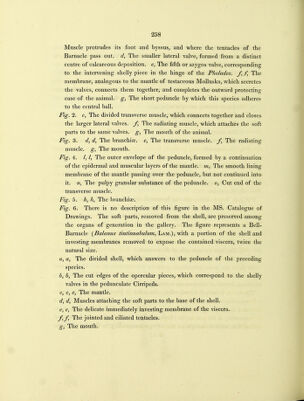
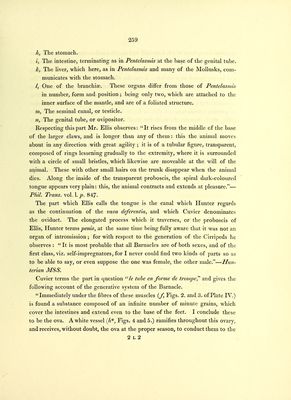
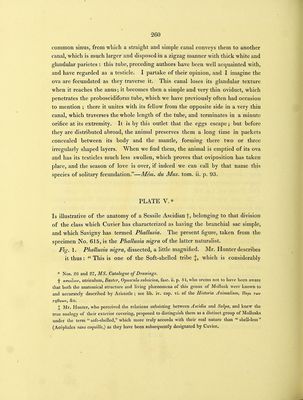
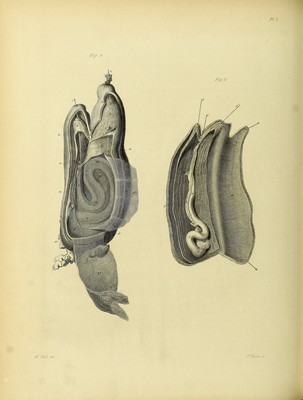
![The stomach. 2, The intestine, terminating as in Pentelasmis at the base of the genital tube. h, The liver, which here, as in Pentelasmis and many of the Mollusks, com- municates with the stomach. /, One of the branchiae. These organs differ from those of Pentelasmis in number, form and position; being only two, which are attached to the inner surface of the mantle, and are of a foliated structure. 7n, The seminal canal, or testicle. n, The genital tube, or ovipositor. Respecting this part Mr. Ellis observes: It rises from the middle of the base of the larger claws, and is longer than any of them : this the animal moves about in any direction with great agility ; it is of a tubular figure, transparent, composed of rings lessening gradually to the extremity, where it is surrounded with a circle of small bristles, which likewise are moveable at the will of the animal. These with other small hairs on the trunk disappear when the animal dies. Along tbe inside of the transparent proboscis, the spiral dark-coloured tongue appears very plain: this, the animal contracts and extends at pleasure.— Phil. Trans, vol. 1. p. 847- The part which Ellis calls the tongue is the canal which Hunter regards as the continuation of the vasa deferentia, and which Cuvier denominates the oviduct. The elongated process which it traverses, or the proboscis of Ellis, Hunter terms penis, at the same time being fully aware that it was not an organ of intromission; for with respect to the generation of the Cirripeds he observes : It is most probable that all Barnacles are of both sexes, and of the first class, viz. self-impregnators, for I never could find two kinds of parts so as to be able to say, or even suppose the one was female, the other male.—Hun- terian MSS. Cuvier terms the part in f[uestion /e tube en forme de tronipe]^ and gives the following account of the generative system of the Barnacle. Immediately under the fibres of these muscles {f. Figs. 2. and 3. of Plate IV.) is found a substance composed of an infinite number of minute grains, which cover the intestines and extend even to the base of the feet. I conclude these to be the ova. A white vessel (A*, Figs. 4 and 5.) ramifies throughout this ovary, and receives, without doubt, the ova at the proper season, to conduct them to the 2 L 2](https://iiif.wellcomecollection.org/image/b21470315_0001_0289.jp2/full/800%2C/0/default.jpg)