Directions for laboratory work in physiology.
- Warren Plimpton Lombard
- Date:
- [1906], [©1906]
Licence: Public Domain Mark
Credit: Directions for laboratory work in physiology. Source: Wellcome Collection.
Provider: This material has been provided by the Augustus C. Long Health Sciences Library at Columbia University and Columbia University Libraries/Information Services, through the Medical Heritage Library. The original may be consulted at the the Augustus C. Long Health Sciences Library at Columbia University and Columbia University.
26/220 page 2
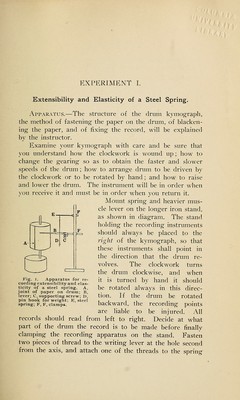
![8 cm. from brass supporting' rod. and the other to a pin hook as shown in diagram. Observe the following cautions: I.—See that the axis of the writing lever is horizontal. 2.—See that the thread connecting the lever with the spring is vertical. 3.—See that the knots are securely fastened. 4.—See that every clamp is screwed firmly in place. Now remove the drum from the k}mograph, fasten a sheet of glazed curve paper smoothly aroinid the drum, and blacken the surface evenly over the gas flame, rotating the drum constantly so as not to burn the paper. Replace the drum, place the kymograph so that the writing lever is tangent to drum surface, touching lightly. Notice that lever writes an arc on a curved surface. If barely touching when horizontal, it will leave the surface and fail to vv'rite as it moves up or down. The lever should press on the drum just enough to write for 2 or 3 cm. above and below the horizontal line falling through its axis. The position of the point with reference to drum and joint of paper is indicated in the diagram. Experiment.—Turn the drum by hand in a clockwise ilirection to draw a base line 3 or 4 inches long. Turn it Lack (taking care not to injure writing points) to the smart- ing point and mark the place by touching the lever lightly. Now turn drum clockwise 3^ cm. and then carefully place a 10 gram weight on the pin hook. Turn same distance again and add another weight. Continue in this manner until 9 weights have been added, then turn the drum Vi cm. once more. The writing point has now recorded the curve of extensibility of the spring. To obtain curve of elasticity, turn drum 3/2 cm. in same direction and remove one weight, and continue in this manner until all the weights are ofif, then turn Yi cm. once more, and mark point by touching lever. The vertical lines on the drum should be of equal length. If they are not, try to account for the error. Since steel is ])erfectly elastic, the writing point should return to the base line. Tf it does not. trv to account for the difference.](https://iiif.wellcomecollection.org/image/b21214554_0026.jp2/full/800%2C/0/default.jpg)