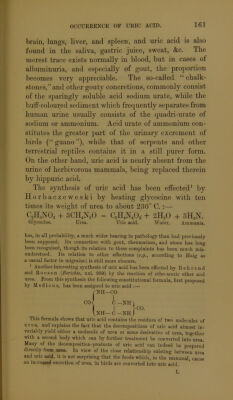
Chemistry of urine : a practical guide to the analytical examination of diabetic albuminous, and gouty urine / Alfred H. Allen.
- Alfred Henry Allen
- Date:
- 1895
Licence: Public Domain Mark
Credit: Chemistry of urine : a practical guide to the analytical examination of diabetic albuminous, and gouty urine / Alfred H. Allen. Source: Wellcome Collection.
180/250 page 162
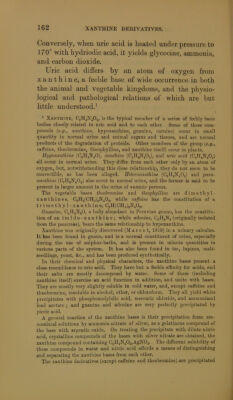
![Conversely, when uric acid is heated under pressure to 170° with hydriodic acid, it yields glycocine, ammonia, and carbon dioxide. Uric acid differs by an atom of oxygen from xanthine, a feeble base of wide occurrence in both the animal and vegetable kingdoms, and the physio- logical and pathological relations of which are but little understood.^ ' Xanthine, C5H4N4O2, is the typical member of a series of feebly basic bodies closely related to uric acid and to each other. Some of these com- pounds {e.g., xanthine, hypoxanthine, guanine, carnine) occur in small quantity in normal urine and animal organs and tissues, and are normal products of the degradation of proteids. Other members of the group {e.g., caffeine, theobromine, theophylline, and xanthine itself) occur in plants. Hypoxanthine (C5H4N4O), xanthine (C5H4N4O2), and uric acid (C5H4N4O3) all occur in normal urine. They differ from each other only by an atom of oxygen, but, notwithstanding this close relationship, they do not seem to be convertible, as has been alleged. Heleroxanthine (CeHgN40o) and para- xanthine (C7H8N4O2) also occur in normal urine, and the former is said to be present in larger amount in the urine of anaemic persons. The vegetable bases theobromine and theophylline are dimethyl- xanthines, C5H2(CH3)2N402, while caffeine has the constitution of a trimethyl-xanthine, CbH(CH3)8N402. Guanine, CbHjNbO, a body abundant in Peruvian guano, has the constitu- tion of an i ni i d o - X a n t h i n e ; while adenine, C5H5N5 (originally isolated from the pancreas), bears the same relationship to hypoxanthine. Xanthine was originally discovered (M a r c e t, 1819) in a urinary calculus. It has been found in guano, and is a normal constituent of urine, especially during the use of sulphur-baths, and is present in minute quantities in various parts of the system. It has also been found in tea, lupines, malt- seedlings, yeast, &c., and has been produced synthetically. In their chemical and physical characters, the xanthine bases present a close resemblance to uric acid. They have but a feeble affinity for acids, and their salts are mostly decomposed by water. Some of them (including xanthine itself) exercise an acid function in addition, and unite with bases. They are mostly very slightly soluble in cold water, and, except caffeine and theobromine, insoluble in alcohol, ether, or chloroform. They all yield white ]>recipitates with phosphomolybdic acid, mercuric chloride, and ammoniacal lead acetate ; and guanine and adenine are very perfectly precipitated by picric acid. A general reaction of the xanthine bases is their precipitation from am- moniacal solutions by ainmonio-nitrate of silver, as a gelatinous compound of the base with argentic oxide. On treating the precipitate with dilute nitric acid, crystalline compounds of the bases with silver nitrate are obtained, the xanthine compound containing C5H4N4O2, AgNOj. The different solubility of these compounds in water and nitric acid affords a means of distinguishing and separating the xanthine bases from each other. The xanthine derivatives (except caffeine and theobromine) are precipitated](https://iiif.wellcomecollection.org/image/b28138818_0180.jp2/full/800%2C/0/default.jpg)