Chemistry of urine : a practical guide to the analytical examination of diabetic albuminous, and gouty urine / Alfred H. Allen.
- Alfred Henry Allen
- Date:
- 1895
Licence: Public Domain Mark
Credit: Chemistry of urine : a practical guide to the analytical examination of diabetic albuminous, and gouty urine / Alfred H. Allen. Source: Wellcome Collection.
181/250 page 163
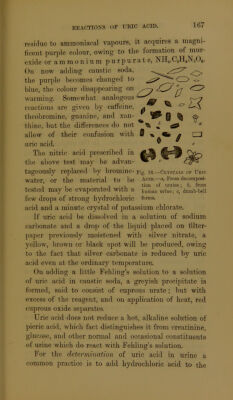
![As commonly obtained, uric acid is said to be anhy- drous,^ and forms small crystalline scales which are very apt to appropriate colouring matter. The microscopic by cupric acetate, especially on heating. The precipitates are the cuprous salts of the bodies, that yielded by xanthine containing Cu20,CgH4N402. They may be produced by treating the neutral solution of the body with a mixture of cupric sulphate and sodium sulphite or thiosulphate, or by mixing the ammoniacal solution with Fehling’s solution, heating to boiling, and gradu- ally adding a solution of dextrose. Instead of cuprous oxide separating in the free state, it combines with the xanthine-derivative to form a white insoluble compound. Hence it is evident that the presence of xanthine and its allies, including uric acid, will prevent the detection of sugar in urine by Fehling’s test to an extent dependent on the amount of the interfering body present. The fact is of considerable practical importance when small quanti- ties of sugar are to be sought for, and therefore, in such case, Fehling’s test should be applied in the modified manner described on page 62. If, instead of using dextrose as a reducing agent, the mixture of a xanthine base with Fehling’s solution be treated with hydroxylamine hydrochloride, reduction of the copper to the cuprous state will occur in the strongly alkaline solution and at the ordinary temperature. P. Balke {Jour. Pract. Cliem., [2], xlvii. 537) employs the foregoing reaction for the determination of the xanthine derivatives, and for their isolation from flesh, malt, &c. The proportion of xanthine derivatives (other than uric acid) ordinarily present in urine is extremely small, but there is reason to believe that, under circumstances not fully understood, their amount is much increased and may then be of pathological importance. For the extraction of xanthine from urine, a large quantity (5 to 10 gallons) should be treated by instalments of about 1 quart at a time with neutral lead acetate in powder, as long as a pre- cipitate is produced. The liquid is filtered and sodium sulphate added as long as lead sulphate is thrown down, the liquid poured off or filtered from the precipitate, copper sulphate added, and the liquid boiled. The precipitate, which contains the xanthine derivatives as cuprous salts, is filtered of!’, washed, dissolved in dilute uitric acid, and excess of ammonia added, followed by silver nitrate. The precipitate, consisting of the argentic oxide compounds of xanthine, &c., is separated, suspended in hot ammoniacal water, and decom- posed by sulphuretted hydrogen, the resultant silver sulphide filtered off, and the filtrate concentrated tUl the xanthine crystallises out. If, instead of de- composing the silver precipitate with sulphuretted hydrogen, it be boiled with nitric acid of I'lO specific gravity, the silver nitrate compounds of hypoxanthine and adenine will crystallise out immediately on cooling, while those of xanthine, paraxanthine, and heteroxanthine will remain in solution, and may be recovered as the silver-oxide compounds by rendering the filtrate ammoniacal. ^ When slowly deposited from dilute solutions, uric acid sometimes separates in large crystals containing CeH4N40s + 2H2O. It is very probable that some of the ordinary forms of uric acid are hydrated. Thus Dr. James Edmunds finds that all crystals of uric acid, obtained by addition of hydrochloric acid to cold filtered urine, effloresce and break up on heating to 200° F. or on exposure in a desiccator at 60° F. over sulphuric acid for twenty-four hours. Prepara- tions made by Dr. Edmunds show thikin a marked manner.](https://iiif.wellcomecollection.org/image/b28138818_0181.jp2/full/800%2C/0/default.jpg)