Chemistry of urine : a practical guide to the analytical examination of diabetic albuminous, and gouty urine / Alfred H. Allen.
- Alfred Henry Allen
- Date:
- 1895
Licence: Public Domain Mark
Credit: Chemistry of urine : a practical guide to the analytical examination of diabetic albuminous, and gouty urine / Alfred H. Allen. Source: Wellcome Collection.
57/250 page 39
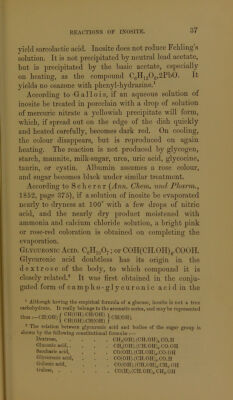
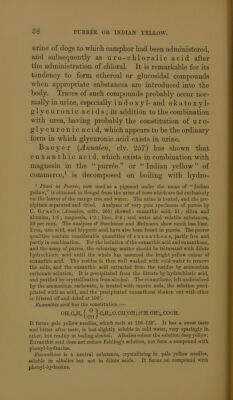
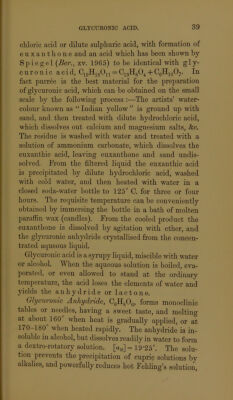
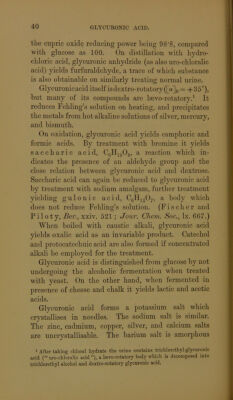
![chloric acid or dilute sulphuric acid, with formation of euxanthone and an acid which has been shown by Spiegel {Ber., xv. 1965) to be identical with gly- curonic acid, C;^9H;^gOji = C^gHgO^ + CgHioO^. In fact purree is the best material for the preparation of glycuronic acid, which can be obtained on the small scale by the following process :—The artists’ water- colour known as “ Indian yellow ” is ground up with sand, and then treated with dilute hydrochloric acid, which dissolves out calcium and magnesium salts, &c. The residue is washed with water and treated with a solution of ammonium carbonate, which dissolves the euxanthic acid, leaving euxanthone and sand undis- solved. From the filtered liquid the euxanthic acid is precipitated by dilute hydrochloric acid, washed with cold water, and then heated with water in a closed soda-water bottle to 125° C. for three or four hours. The requisite temperature can be conveniently obtained by immersing the bottle in a bath of molten paraffin wax (candles). From the cooled product the euxanthone is dissolved by agitation with ether, and the glycuronic anhydride crystallised from the concen- trated aqueous liquid. Glycuronic acid is a syrupy liquid, miscible with water or alcohol. When the aqueous solution is boiled, eva- porated, or even allowed to stand at the ordinary temperature, the acid loses the elements of water and yields the anhydride or lactone. Glycuronic Anhydride, CgHgOg, forms monoclinic tables or needles, having a sweet taste, and melting at about 160 when heat is gradually applied, or at 170-180° when heated rapidly. The anhydride is in- soluble in alcohol, but dissolves readily in water to form a dextro-rotatory solution. [aj)] = 19*25°. The solu- tion prevents the precipitation of cupric solutions by alkalies, and powerfully reduces hot Fehling’s solution,](https://iiif.wellcomecollection.org/image/b28138818_0057.jp2/full/800%2C/0/default.jpg)